In this Issue:
- AI Data Centers: Putting Texans at the Center of Data Center Development
- Carbon Capture and Storage in Texas
- Toxic Wastewater for Our Crops? Lessons We (Should Have) Learned from PFAS Chemicals
- Rally by the River: Using the Clean Water Act to Protect Drinking Water
- Spring for Water Benefit Bash 2026
- National Updates
AI Data Centers: Putting Texans at the Center of
Data Center Development
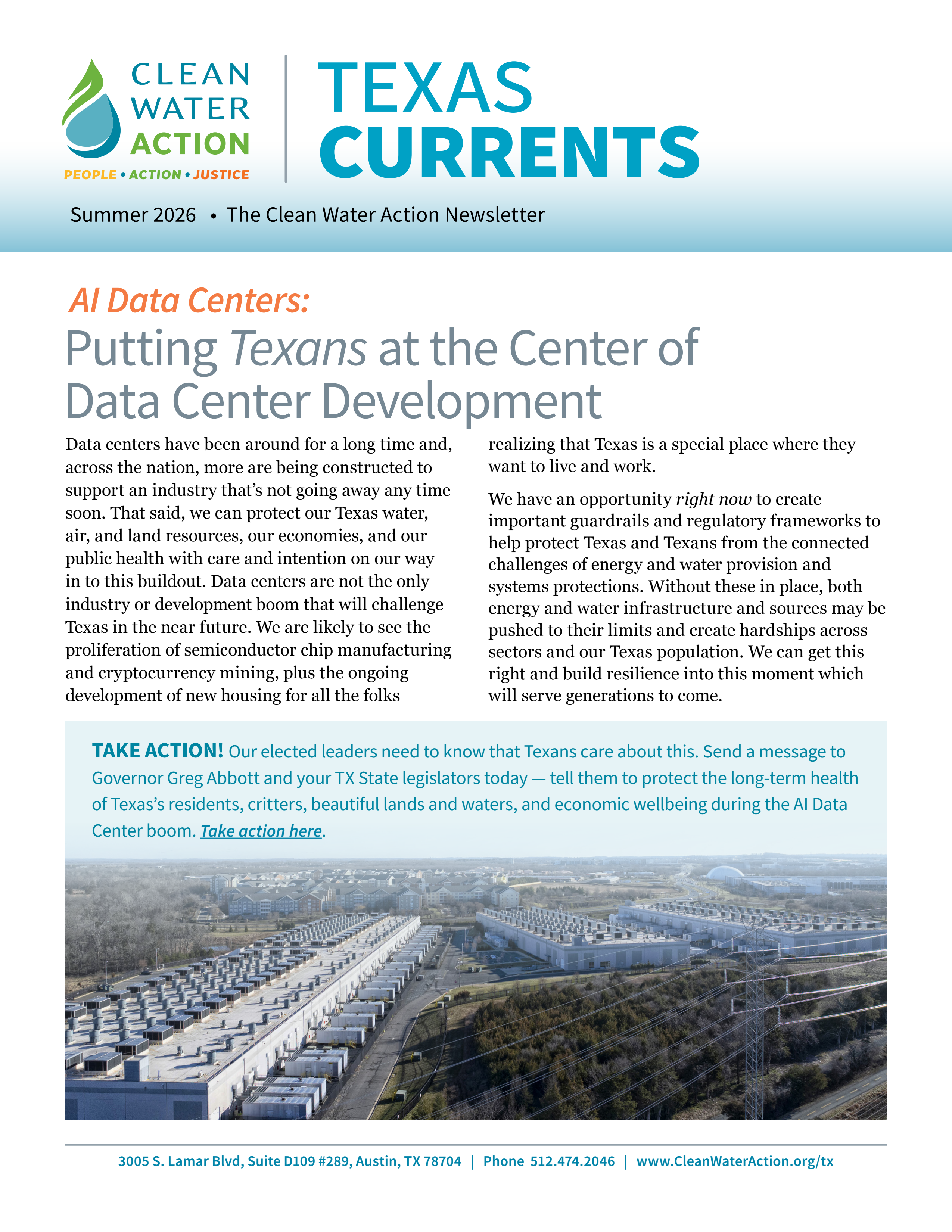
Data centers have been around for a long time and, across the nation, more are being constructed to support an industry that’s not going away any time soon. That said, we can protect our Texas water, air, and land resources, our economies, and our public health with care and intention on our way in to this buildout. Data centers are not the only industry or development boom that will challenge Texas in the near future. We are likely to see the proliferation of semiconductor chip manufacturing and cryptocurrency mining, plus the ongoing development of new housing for all the folks realizing that Texas is a special place where they want to live and work.
We have an opportunity right now to create important guardrails and regulatory frameworks to help protect Texas and Texans from the connected challenges of energy and water provision and systems protections. Without these in place, both energy and water infrastructure and sources may be pushed to their limits and create hardships across sectors and our Texas population. We can get this right and build resilience into this moment which will serve generations to come.
Take Action!
Our elected leaders need to know that Texans care about this. Send a message to Governor Greg Abbott and your TX State legislators today — tell them to protect the long-term health of Texas’s residents, critters, beautiful lands and waters, and economic wellbeing during the AI Data Center boom. Take action here.
Carbon Capture and Storage in Texas
What is Carbon Capture and Storage (CCS)?
Carbon capture and storage is a combination of technologies marketed by oil and gas companies as a tool to remove the greenhouse gas carbon dioxide (CO2) from the air and store it underground. However, CCS projects worldwide have largely failed to reach projected emission reductions. Even if all the technical and economic structures were in place for CCS to work as intended, Texas has a weak oversight structure that will likely result in harm to public health, safety, and drinking water if more CCS infrastructure is built here.
Is Texas ready for widespread, commercial use of CCS?
Our state agency, the Railroad Commission of Texas (RRC), has a history of poorly regulating conventional oil and gas operations which has led to numerous unresolved pollution issues; blown out wells which were improperly shuttered; and increased subsidence and earthquake activity linked directly to oil and gas underground injection activities. Additionally, there are no federal rules regulating CO2 pipeline safety as a backstop to a lack of state rules. We risk repeating Class II oversight failures with Class VI oversight for CCS and the dangers are many and serious.
Clean Water Action and our allies call for meaningful community engagement, transparency, worker and neighbor health and safety protections, as well as financial fairness for communities in which any new CCS facilities are permitted and operated.
Potential Impacts and Risks for Texas:
Carbon capture and storage poses significant risks to human health and the environment such as:
- Hypoxia, or suffocation from leaks;
- Acidification and irreversible contamination of underground drinking water resources;
- Earthquakes, sinkholes, and legacy well blowouts which pollute the land and surface water;
- Eminent domain threats where private companies can take land and pore space against an owner’s will;
- Climate fraud from the CO2 not staying in the ground for the thousand years necessary to be significant;
- Draining local financial resources by offering costly tax abatements and avoidance.
What Are Some Solutions?
- Ensure sufficient financial liability and perpetual monitoring after injection well site closure;
- Prevent conversion of Class II wells to Class VI wells; and existing oil & gas pipelines to CO2 pipelines;
- Reform pipeline safety rules and eminent domain for carbon dioxide;
- Fund emergency response plans, personnel, equipment, and training;
- Consider compound impacts and historical environmental injustice when planning CCUS projects;
- Demand Community Benefits Agreements that are collaborative, meet the needs of the community, and are not used to justify pollution.
Legislative Lunch & Learn
On April 30th, Clean Water Action and Commission Shift, both leaders in the Texas Carbon Capture and Storage Community Coalition, hosted West Texas rancher Schuyler Wight as a special guest to brief legislators and staff at the state capitol. Schuyler shared his first-hand knowledge about threats to groundwater from improperly closed and abandoned oil and gas wells, like the highly-acidic groundwater leachate coming up on his ranch.
One Last Thing on Carbon Capture and Storage
In late 2025, the state of Texas’s oil and gas regulating agency, the Texas Railroad Commission (RRC) requested and was granted control of CCS permitting and regulation in Texas from the United States Environmental Protection Agency (US EPA). This control is known as “primacy.” Companies that wish to operate carbon capture and storage in Texas will be governed by this state agency operating the federal Safe Drinking Water Act’s Underground Injection Control program for Class VI injections. Since then, in 2026 alone, there have been eight newly proposed CCS injection projects seeking permits.
Toxic Wastewater for Our Crops? Lessons We (Should Have) Learned from PFAS Chemicals
In other subsurface pressure news, “produced water” has been causing problems across our landscapes and groundwater resources for decades due to its being injected underground. Produced water is a byproduct of oil and gas extraction and is a complex industrial wastewater that can contain carcinogens, heavy metals, radioactive materials, and a wide range of chemicals that remain undisclosed due to trade secret protections.
Geysers and leaking and abandoned wells have contaminated groundwater and spilled and spewed oil and gas waste products, leading to ground deformation and increased earthquakes across Texas.
In search of a new place to “put” this waste product, Texas regulators are considering applying it to land after treatment. Our Texas Commission on Environmental Quality (TCEQ) has proposed to treat this toxic oil and gas wastewater under the same rules as everyday household sewage and light industrial wastewater, and then apply it to land, possibly including agricultural land. Under the existing rule, the treated produced wastewater product could potentially be routed to other industrial uses and even discharged into Texas’s rivers. This would be a dangerous shortcut that would not provide the safety measures needed to protect human health or the natural environment.
“Public involvement in this plan is a legal requirement,” Texas Director Becky Smith noted. “Community members who are the most likely affected by this rulemaking are, frankly, in the dark. TCEQ should pause, extend the public comment period, and hold more public hearings in communities that will be impacted by this waste, thereby giving people more time to learn about this rulemaking and weigh in on it.”
We and our allies in Texas are calling on TCEQ to abandon this attempted shortcut to slot a new type of dangerous wastewater product into existing rules. We need them to set strict standards for treatment, testing, and enforcement to keep food and water safe from the toxic chemicals found in oil and gas produced wastewater. Clean Water Action and many other concerned residents and organizations testified to TCEQ in a June 12th hearing as well as through written comments into the public record for the rulemaking. A decision is forthcoming in response to the comments and concerns; TCEQ has not responded to our requests to extend the comment deadline or to conduct additional outreach to communities across the state.
Rally by the River: Using the Clean Water Act to Protect Drinking Water
Lynn Thorp, Clean Water Action President, and Julie MacNamara, National Water Projects Coordinator, met Texas Director Becky Smith in San Antonio this spring for River Rally, a gathering held every two years by the River Network with over 400 attendees. As one of the leaders of the Clean Water for All Coalition, Clean Water Action was asked to present on our work using the Clean Water Act’s tools to protect drinking water.
Becky spoke about projects here in Texas, such as using the citizen advocacy provision in the Clean Water Act’s National Pollution Discharge Elimination System (NPDES) permit process to challenge contaminated coal plant wastewater discharges to nearby waterways. She also featured a toolkit developed by Julie MacNamara, which uses EPA data and mapping provided publicly under Clean Water Act provisions to identify potential sources of drinking water contamination.
River Rally was an inspiring and energizing conference filled with dedicated local activists using these and other tools to win victories in their cities, states, and tribal lands, as well as sharing best practices to win more campaigns around the nation.
Spring for Water Benefit Bash 2026
In May, members and supporters gathered at Austin’s beloved Chez Zee American Bistro to celebrate together in community, learn from our special guest speaker West Texas rancher Schuyler Wight, and fundraise support for Clean Water Action’s work in the year ahead.
Guests enjoyed live jazz piano and both silent and live(ly) auctions of items donated by local businesses and artists, including hand-printed apparel from The Maude Complex Shop, fine and casual dining all across Austin, and overnight stays in Alpine, Houston, New Mexico, and New Orleans.
NATIONAL UPDATES
EPA Proposes to Roll Back PFAS Drinking Water Protections
In 2024, the Environmental Protection Agency (EPA) finalized the nation’s first drinking water standards for six toxic PFAS “forever chemicals,” a major victory for public health after years of advocacy. Now, the Trump administration is proposing to rescind protections for PFHxS, PFNA, GenX chemicals, and PFAS mixtures while also creating a pathway for some water systems to delay compliance with the remaining PFOA and PFOS standards until 2031. PFAS contamination has been found in drinking water sources across the country and exposure to these chemicals has been linked to cancer, immune system suppression, developmental harms, and other serious health effects.
Clean Water Action strongly opposes these rollbacks. Communities should not be forced to wait longer for protection from toxic chemicals in their drinking water. Instead of weakening safeguards, EPA should accelerate efforts to prevent PFAS pollution at its source, hold polluters accountable, and strengthen protections for public health. During the public comment period, Clean Water Action is mobilizing members and allies to urge EPA to reject these proposals and maintain strong federal drinking water standards for PFAS. Take action today before the comment period closes July 20, 2026.
Honoring Excellence in Lead Pipe Replacement
On June 23rd, the Lead Service Line Replacement Collaborative recognized 16 people and programs leading the charge to remove lead from the nation’s drinking water systems. During the recognition ceremony, Lynn Thorp, President of Clean Water Action and Lead Services Line Replacement Collaborative Steering Committee member, presented the block of awards related to excellence in community engagement, ensuring equal access to replacement, promoting public health protection, and other aspects of program design that reflect a collaborative approach to getting the job done. Read more here.
EPA’s Latest Giveaway to the Coal Industry
Clean Water Action has worked on securing stronger wastewater limits for coal plants for more than 13 years. In 2024, EPA finalized long-overdue protections to help control the hundreds of millions of pounds of toxic pollution being released by coal plants each year. Yet, in December 2025, EPA extended compliance deadlines by up to five years, prolonging the release of dangerous pollutants into our waterways. Now, in a second giveaway to the coal industry, EPA is proposing to weaken federal wastewater standards at up to 113 coal plants across the country. The proposed rule would threaten drinking water, damage critical ecosystems, and put the health of communities across the country at risk.
During the comment period, we spoke out at meetings with EPA, mobilized thousands of comments urging EPA to withdraw its plans, and coordinated a community comment letter with nearly 65 national, state, and local organizations opposing the rule. Thank you for helping us push back against EPA’s latest giveaway to the coal industry.
Yale Environmental Fellows Program
Our National Campaigns Team is excited to welcome two fellows for the summer from the Yale Environmental Fellows Program and the Yale Conservation Scholars-Early Leadership Initiative: Jagur Parks and Brandi Williams. As part of their first week, they had the opportunity to visit Climate Action Campaign’s unique pop-up, the Museum of Unnatural Disasters. This moving exhibit highlighted how extreme climate events are affecting us all through artifacts and survivor stories.
Juneteenth and Environmental Justice
Juneteenth is a celebration of liberation, resilience, and the ongoing struggle to ensure that the promise of freedom is realized for everyone. As part of our efforts commemorating this important day, we’re proud to highlight the environmental justice work happening across Clean Water Action. Read about it in our latest blog.
CURRENTS is published by Clean Water Action and Clean Water Fund. Reproduction in whole or part is permitted with proper credit. © 2026 All rights reserved.