In This Issue:
National News
- Making a Difference to Elect Pro-Environmental Candidates
- Clean Water Rollback
- Protecting Drinking Water from Oil and Gas Wastewater Pollution
- No Denying Climate Change Town Hall Series
- Honoring Excellence in Lead Service Line Replacement
State and Regional News
- California
- Chesapeake (DC, Maryland, Virginia)
- Michigan
- Minnesota
- New England (Connecticut, Massachusetts, Rhode Island)
- New Jersey
- Pennsylvania
- Texas

Making a Difference to Elect Pro-Environmental Candidates
With the Republican-led charge to redistrict the U.S. House of Representatives ahead of the mid-term elections this fall, fewer and fewer races are actual competitions for voters. With the control of the U.S. Congress at stake, Clean Water Action is making a difference talking to voters in battleground districts across the country. Below are three Congressional districts that remain toss-ups where control of Congress could come down to just a few thousand votes:
Pennsylvania’s 7th Congressional District: Clean Water Action has worked on environmental issues in the Lehigh Valley since the late 1980s, a part of the state that has swung back and forth politically for years. Clean Water Action was excited to endorse Bob Brooks for U.S. House, who has been the union President of the Pennsylvania Professional Fire Fighters Association, a group that has strongly backed efforts to get PFAS forever chemicals out of firefighting foam, one of the main ways drinking water in PA has been contaminated with PFAS.
Michigan’s 7th Congressional District: In mid-Michigan, Clean Water Action has endorsed William Lawrence for U.S. House to unseat incumbent Tom Barrett. Lawrence has been a community organizer and climate activist who comes from outside the political system, with a broad platform to protect our health, our water, and our communities.
California’s 22nd Congressional District: Clean Water Action has worked in Kern County for over a decade to support a majority Latino community impacted by pollution from both oil and gas drilling and agriculture. Randy Villegas won Clean Water Action’s endorsement for U.S. House because of his long history in the district as a social justice educator and advocate. Villegas supports the needed changes to a green economy that will help residents realize their rights to clean and affordable water.
Every day, Clean Water Action is out talking to voters in person and on the phone, providing information that is independent of the political parties and moves people to vote for the changes we all need. You can do your part by being a Clean Water Voter, learn more here: https://cleanwater.org/be-clean-water-voter
Clean Water Rollback
The Environmental Protection Agency (EPA) and Army Corps of Engineers have proposed additional changes that could sharply reduce the number of streams and wetlands protected by the Clean Water Act. The new options would generally limit protections to streams that hold or carry water essentially year-round and wetlands that maintain a near year-round surface-water connection to another protected water, leaving many waters that naturally dry out during part of the year outside federal protections. EPA is considering these new options alongside the proposal released last year, with public comments due October 9.
These changes could have major consequences for water quality, drinking water, flood protection, and healthy watersheds, particularly in parts of the West where seasonal streams are common. Even EPA and the Army acknowledge that the new approach would narrow the scope of waters covered by the Clean Water Act compared with current implementation. As written, this proposal would leave the Act so broken, it would render it unusable as a water protection tool for a large part of the country.
Clean Water Action has made this a national campaign. Our canvass teams are talking with members and collecting comments to submit to EPA, while our national program staff are developing detailed comments and working with environmental partners on coalition submissions. Together, these efforts will put both the voices of our members and the policy expertise of Clean Water Action into the official record before EPA and the Army decide how to move forward.
Protecting Drinking Water from Oil and Gas Wastewater Pollution
Clean Water Action and Clean Water Fund's latest report, as part of our Putting Drinking Water First series, examines how weakening Clean Water Act oil and gas wastewater pollution limits would threaten drinking water.
EPA is planning to rollback limits on the release of oil and gas wastewater, known as “produced water.” Produced water is a complex mix of naturally occurring constituents like salts (or total dissolved solids (TDS)), heavy metals, and even radioactive materials, as well as other chemical additives used during the oil extraction process. Trump's EPA has expressed interest in expanding the geographic area where produced water is allowed to be released and exploring the use of produced water for additional purposes, including data center cooling.
This paper examines the risks associated with this harmful wastewater, highlights its impact on downstream drinking water, and identifies the significant knowledge gaps that remain. Overall, EPA should be strengthening, not weakening, wastewater discharge standards for the oil and gas industry. We call on EPA to halt plans to weaken these wastewater pollution limits, hold the industry accountable for their harmful wastewater, increase transparency, fill critical gaps in knowledge, and ensure meaningful stakeholder engagement. Doing so would better safeguard drinking water sources, reduce costly downstream treatment, prevent other environmental impacts, and protect surrounding communities.
No Denying Climate Change Town Hall Series:
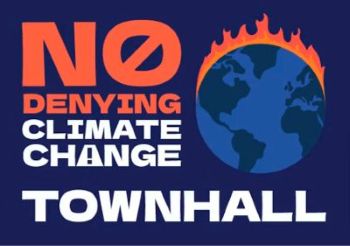
We are joining Climate Action Campaign in promoting the “No Denying Climate Change” town hall series, which brings together activists and their members of Congress. The series kicked off with a national youth-focused town hall featuring our youngest member of Congress, U.S. Representative Max Frost (FL-10), where over 220 attendees showed up to speak out against the climate crisis. The next in the series will be with U.S. Rep Jared Huffman on October 21, 2026. Register here for the in-person event in San Rafael, CA.
Honoring Excellence in Lead Service Line Replacement
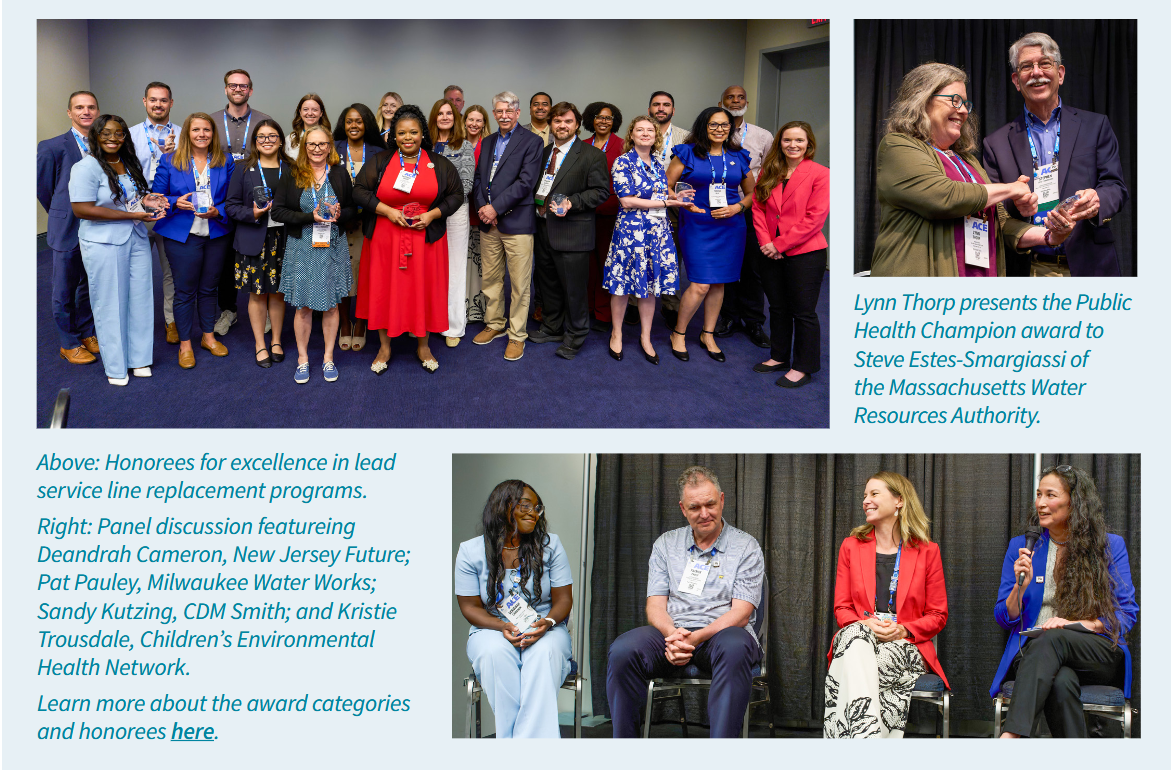
On June 23, Clean Water President Lynn Thorp had the honor of participating in a Lead Service Line Replacement Collaborative event — held during the American Water Works Association’s annual convention in Washington DC — recognizing 16 people and programs leading the charge to remove lead from the nation’s drinking water systems.
Since 2016, the 28-organization Collaborative has worked to accelerate lead service line (LSL) replacement by providing how-to resources, amplifying good practices, and facilitating cross-sector collaboration. Clean Water is proud to have helped found the Collaborative and to serve on the Steering Committee.
Prior to 1986, LSLs were often used to connect water mains under the street to a building’s plumbing. The U.S. EPA’s latest estimate is that over 4 million LSLs remain connected to water systems in the United States. There is no safe level of lead. It is especially harmful for young children, affecting brain development and contributing to lower IQs.
State and Regional News
CALIFORNIA
Water Affordability
Disappointingly, Governor Newsom vetoed SB 1125, which would have established a statewide low-income water rate assistance program. He also vetoed a companion bill, AB 2739, which would have established a funding mechanism for the program. Water affordability has been one of Clean Water Action’s top priorities since 2021, and we will continue our work to make it a reality.
Kern County
We are excited to welcome two new organizers in Kern County. Paola and Vanessa are conducting a health survey among the residents of Lost Hills, developed with our community partners and Fresno State Health Institute. This survey will provide needed data to decisionmakers on the health impacts of living in a fenceline community that is adjacent to multiple pollution sources and will amplify the voices of those living in this historically-marginalized community.
ReThink Disposable
ReThink is excited to announce our partnership with the University of Georgia and the City of Berkeley to conduct a Circularity Assessment Protocol (CAP). We are looking forward to collecting data to expand the ReThink program beyond single-use disposable foodware! We hope that other Bay Area cities and counties take advantage of this exceptional opportunity to gather statistical data to build more robust zero waste plans.
Clean Water Action in the Community
Our Legislative Director, Andria Ventura, is co-hosting (with Children Now) a webinar series called Bite Size Enviro Health: Lunch & Learn. Each webinar features a panel of subject matter experts discussing issues critical to children’s health. The first event discussed the basics of safe drinking water, and September’s webinar featured Dr. Anna Reade, Director of PFAS Advocacy at National Resources Defense Council and Nancy Buermeyer, Program and Policy Director at Breast Cancer Prevention Partners, joining Andria to discuss the impacts of PFAS (“forever chemicals”) on humans and the environment. Keep an eye on Clean Water Action California’s website and social media outlets for the next installment.
CHESAPEAKE REGION
Zero Waste
In Maryland, we were thrilled this year to pass important Zero Waste legislation through the state’s General Assembly, creating grant programs to fund on-farm composting systems and food rescue efforts and getting these programs funded in this year’s budget. We’ll keep working for more resources for Zero Waste throughout the state, and we’re working now to bring back our priorities on environmental justice, safer septic systems, and PFAS protections in the 2027 legislative session.
We’re also working hard at the local level In Baltimore City, our years-long advocacy efforts for the City budget to invest more in Zero Waste alternatives are bearing fruit, and in Baltimore County, we’re working against a potential renewal of the County’s contract to send waste to the incinerator.
Upgrade Maryland
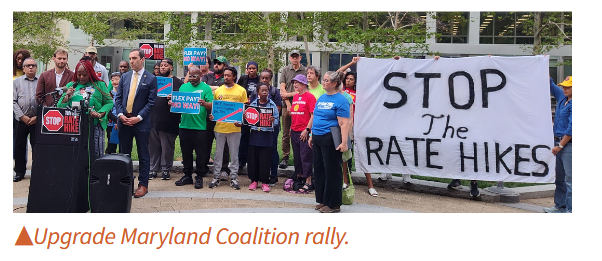
We’re stepping up our efforts to protect Marylanders from high utility bills and spending on methane gas infrastructure with the Upgrade Maryland coalition. Since 2010, Baltimore-area gas delivery rates have tripled, far exceeding inflation. While they’ve sought to justify many of these increases with investments in costly infrastructure projects, the lion’s share has gone to their highly-criticized gas pipeline replacement program — a program that analysis suggests is prioritizing profits and gas system expansion over safety and consumer benefits. We rallied with the coalition in front of utility company headquarters in downtown Baltimore in August, and we’re mobilizing for state hearings on the Future of Gas this fall.
Incinerator
In Howard County, Clean Water Action is supporting the Stop Grace Coalition, a community group fighting against a Pyrolysis Incinerator that the Maryland Department of the Environment has allowed W.R. Grace to push through the permitting process directly against community wishes. This fight is at a key moment now as MDE considers approval of a final permit to operate the facility. If MDE approves the permit, it will not be the end of the fight, but will be a major setback to community efforts.
MICHIGAN
Money Out of Politics
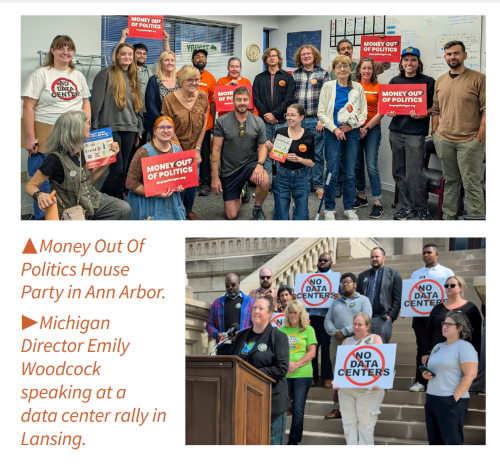
Michiganders For Money Out Of Politics is on the ballot and Clean Water Action is working to make sure all voters know to vote YES ON 2 this November! MMOP would ban political donations from regulated utilities and large government contractors and require disclosures on campaign advertising. For too long these corporations have bought influence with our lawmakers. We need your help to spread the word so we can win for Michigan! Get involved today at MopUpMichigan.org and find voting information at cleanwater.org/voteMI.
Data Centers
We are also continuing our work to put a stop to the data center frenzy before the end of this legislative session. Clean Water Action has joined allied organizations and residents fighting big tech in their backyards in urging our Lansing lawmakers to take action and pass a moratorium on data center development alongside strong, enforceable standards to protect communities and our environment. Send your own message at cleanwater.org/datacenters.
Line 5
Big news on the fight to shut down Line 5 and stop the destructive tunnel project! The Michigan Supreme Court sent back a tunnel permit that did not adequately address environmental concerns for additional consideration. Following that, Governor Whitmer and the Michigan Department of Environment, Great Lakes, and Energy reopened review of other state tunnel permits. Gov. Whitmer also recommitted to getting the 73 year old pipeline out of our waters for good. This is great news, but we need words to be followed by action to protect our Great Lakes for future generations. Take action and get involved at OilAndWaterDontMix.org.
MINNESOTA
Legislative Agenda
Clean Water Action Minnesota remains committed to defending PFAS regulations under Amara’s Law; passing a moratorium on new AI hyperscale data center construction, and at minimum reining in the proliferation of these facilities and heavily regulating them; strengthening protections for manoomin (wild rice) and the Boundary Waters; and protecting Minnesotans from harmful toxic substances like lead, nitrates, and paraquat dichloride. Coalition meetings have surrounded those legislative priorities and the electoral context of achieving those priorities.
Congressional Accountability
The Minnesota office has also received grant funding for community organizing efforts in Congressional District 1, centered around congressional accountability and building autonomous, self-sufficient community organizing infrastructures of local volunteers talking to their neighbors about issues which impact their communities. This organizing has focused on Red Wing and Rochester, with ambitious goals to expand into other locations in Southeastern MN.
ReThink Disposable and E-Waste
Clean Water Action Minnesota is wrapping up the current phases of its ReThink Disposable and E-Waste Fix It Clinics programs. These programs have produced amazing results among local businesses, schools, and households to reduce the amount of single-use plastics and electronic waste (e-waste) ending up in our waste streams. The Minnesota team anticipates the next phases of these programs to include more policy work at the local and state levels to continue to support these waste reduction efforts.
NEW ENGLAND (Connecticut, Massachusetts, Rhode Island)
CONNECTICUT
ReThink Disposable
Connecticut’s ReThink Disposable team had a massively successful summer helping local races and other outdoor events stop trash before it starts. Amber Schmidt, the New England Zero Waste Organizer, brought Clean Water Action’s new water refill station and boxes of reusable cups to Middletown Pride, multiple Cedar Lake Tri race days, and the Killingworth Road Race.
Hundreds of disposable cups and single-use water bottles were kept out of the trash at each event, and athletes remarked at how simple and easy it was to make the switch. Rather than piles of crumpled single-use cups at each water station, athletes were greeted with Clean Water Action staff carefully sorting reusable cups to be washed and sterilized for the next event. The water refill station was acquired with the generous support of the Rockfall Foundation and the Community Foundation of Middlesex County.
MASSACHUSETTS
Data Centers and Zero Waste
Over 100 Tufts University first-years joined Clean Water Action organizers to talk to Boston residents about data center policy and Zero Waste dining. The effort was part of Tufts University’s SHAPE program, a pre-orientation opportunity for incoming first-years to get involved in local civic action while getting to know Boston.
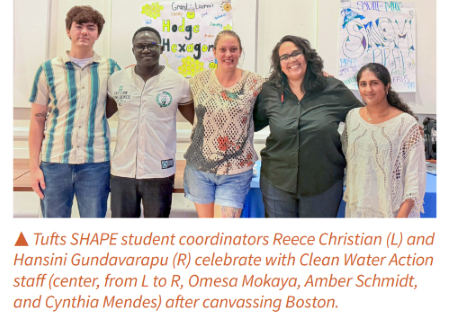
The students canvassed and surveyed nearly 700 residents and found overwhelming concern about data center development in the Commonwealth with a large majority supporting a moratorium on data center development. The students also fanned out specifically in Jamaica Plain to spread the word about the growing Zero Waste dining movement that Clean Water and our partners JP Zero Waste have been spearheading.
RHODE ISLAND
Chemical Safety Laws
The Rhode Island team is in a key position to influence national toxic chemical policy. State Director Emily Howe has been meeting with U.S. Senator Sheldon Whitehouse and his staffers, both in Washington and in Rhode Island, to ensure that the federal Toxic Substances Control Act (TSCA) is not weakened. Senator Whitehouse, the ranking member of the Senate Environment and Public Works Committee, is fighting to defend key safety provisions in TSCA from Republican attacks and giveaways to the chemical lobby. Clean Water Action is making sure that the voices of everyday Americans are at the table, too.
NEW JERSEY
Reducing Waste and Toxics
Skip the Stuff went into effect on August 1. Restaurants are saving money, and waste is being reduced by customers getting only single-use cutlery and condiments that are wanted. Clean Water Action is now leading the educational campaign that involves NJ agencies, youth, and other activists throughout the state. Case studies are being conducted to document waste reduction and cost savings. Please reach out if you want to take action during this process!
Governor Sherrill just signed into law S1281/A5048 to eliminate “forever chemicals” in the PFAS family from apparel and diapers. Now, Clean Water Action has written new legislation, just introduced in the Assembly, to eliminate microplastics from products that are likely to enter our bodies like chewing gum and cosmetics. Please take action and help promote Protection Against Microplastics Act (A5452).
On a global level, Clean Water Action’s Marta Young has been asked by Break Free From Plastic (BFFP) to be one of 16 to represent North America in developing a global plastic reduction strategy. She heads to Kuala Lumpur, Malaysia in October for deep conversations about what has worked over the past 10 years and to help the global movement ensure a healthier and less polluted world.
Clean Air
Throughout the summer and into the fall, Clean Water Action is expanding its truck counts and port tours to continue advancing grassroots support for our Kids Clean Air Zone Campaign. Collaboration continues with the Coalition of Healthy Ports to advance statewide clean air policies like the NJ Indirect Source Review (ISR) bill. Clean Water Action also recently welcomed a new member to the team — Zero Emissions intern, David France, who will be helping with social media engagement and communications for our Zero Emissions Now campaign work.
Make Polluters Pay
Clean Water Action co-leads the statewide Make Polluters Pay Coalition, which is focused on passing S. 2338 before year end. It would secure $50 billion over 20 years from the big oil extractors (the stockholders of ExxonMobil and BP) for climate resiliency projects, transportation upgrades, help for farmers, schools, and emergency responders in extreme heat, and more. We recently held huge rallies in Jersey City and Newark with their mayors, other state and local officials and youth activists. With our leadership, Newark just joined the 80 other municipalities in passing a resolution urging the legislature to vote in favor. The momentum is on our side — take action today.
Flipping the House
New Jersey has a key toss-up race (CD7) that could flip the U.S. House to be more pro-environment. We would love to replace Tom Kean Jr. (18% lifetime environmental rating) with newcomer Rebecca Bennett, who is an advocate for many of the issues we care about most. Additionally, we made endorsements for long-time champions U.S. Senator Booker and Congressman Pallone (CD6); those relatively new to Congress — Conaway (CD3), Menendez Jr. (CD8), Pou (CD9), McIver (CD10) Mejia (CD11); and first-timer Adam Hamawy (CD12). Learn about how to be a Clean Water Voter here.
Big Bad Data Centers
Clean Water Action is co-leading a statewide effort to urge Governor Sherrill to establish a data center moratorium for projects that have over 20 megawatts (MW). These projects can range from 100,000 sq ft (roughly the physical footprint of a large retail store like a Target) to 2.6 million sq ft, on the massive scale of 45 NFL football fields. Nearly 100 NJ towns have passed ordinances that ban large data centers and prevent the conversion of empty warehouses into these tech facilities.
Over 2 million New Jersey residents now live in municipalities with a data center ban. Clean Water Action is providing local towns with a Model Data Center Ordinance, a framework for municipalities to define data centers and designate them as a non-permitted use in all zones. Check out our Big Data Center, Bigger Impact page to stay informed.
PENNSYLVANIA
What’s at Stake in 2026 Elections
Clean Water Action has endorsed Bob Brooks for Pennsylvania Congressional District 7 in the Lehigh Valley. This is an opportunity to flip a seat and replace a career politician with an awful track record on environmental issues with the union President of the Pennsylvania Professional Fire Fighters Association who knows we need policies on climate, energy, air and water that work for working families, not just big oil and tech companies.
We also need the right type of state legislators in office if we’re going to overcome the barriers that stalled passage of bills in the Pennsylvania General Assembly which would’ve protected rate affordability by requiring data centers to bring their own energy, addressed exposure to toxic PFAS chemicals, safeguarded environmental justice communities from additional pollution and modernized the amount of energy we generate from renewable sources, like solar. Before you go to the polls, also check out our state legislative scorecard to see incumbents’ voting records on recent environmental bills. Be a Clean Water Voter in the general election on Tuesday, November 3rd by supporting our slate of environmental candidates.
TEXAS
Legislative Priorities
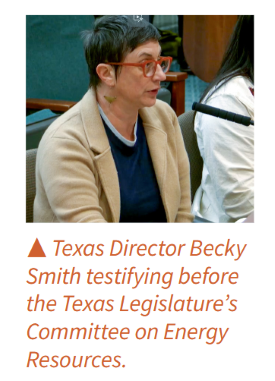
The next legislative session will begin in January 2027. Until then, there are “Interim Charges” and “Interim Hearings” at the Texas Capitol which queue up issues, testimony, and bill language for take-up in the session. Looming large in the Texas House and Senate is the issue of energy and water use by data centers; and treatment and disposal of oil and gas wastewater, called “produced water,” which has historically been injected underground but is causing seismic activity and nearby well blowouts when injected.
Carbon Capture & Storage Coalition (CCSC) and the Railroad Commission of Texas (RRC)
Clean Water Action’s goals are to protect groundwater resources from pollution by high-pressure CO2 injection activities and to protect communities, public health, and the public’s tax dollars from the negative effects of rushing through the science and permitting.
In a 2-1 vote of the three statewide elected Commissioners of the errantly-named Railroad Commission of Texas (RRC), ExxonMobil was granted the very first permit for a carbon dioxide underground injection project since the state’s agency took over the program from the United States Environmental Protection Agency. This was an upsetting outcome for members of the community of Cheek, Texas, who rallied by the busload on September 15 at this final hearing in Austin of the Railroad Commission. Their land, groundwater, property, homes, and agricultural way of life will inevitably suffer disruption, though hopefully no emergency leaks or explosions from the highly pressurized CO2 that will be pumped into underground pore space beneath them. Conventional steel and concrete have not proven to prevent leaks. Potential is high for CO2 escaping through known and unknown abandoned and orphaned oil and gas wells, as is the potential for acidifying groundwater. ExxonMobil will receive $85 per ton of stored gas from federal tax incentives and only $2 per ton will be set aside in dedicated funds for shutdown of the operations. This does not account for funding for safety or emergency response needs.
There are many additional CCS facilities proposed in Texas with four in the active permitting process with the Railroad Commission.