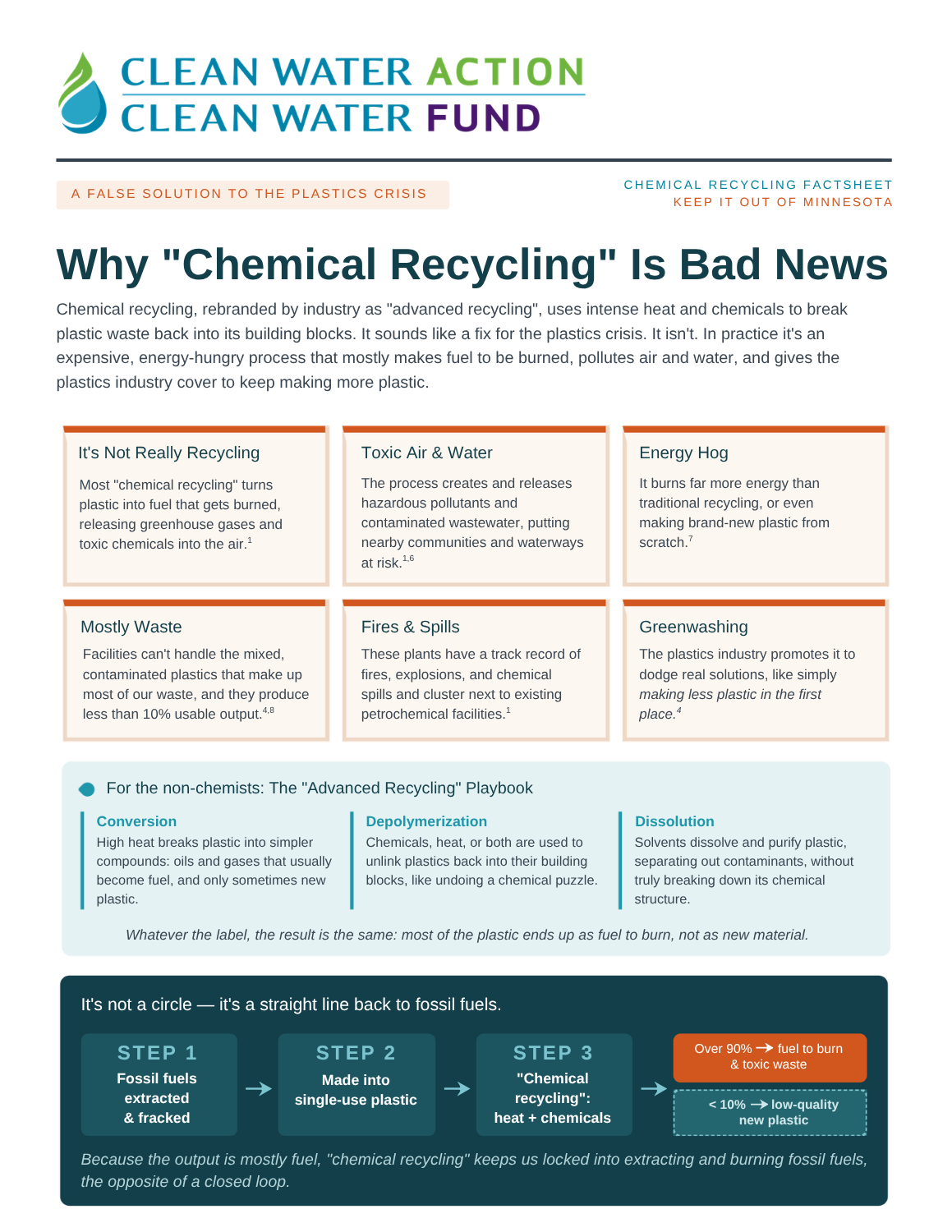
Chemical recycling, rebranded by industry as "advanced recycling", uses intense heat and chemicals to break plastic waste back into its building blocks. It sounds like a fix for the plastics crisis. It isn't. In practice it's an expensive, energy-hungry process that mostly makes fuel to be burned, pollutes air and water, and gives the plastics industry cover to keep making more plastic.
It's Not Really Recycling. Most "chemical recycling" turns plastic into fuel that gets burned, releasing greenhouse gases and toxic chemicals into the air.1
Toxic Air & Water. The process creates and releases hazardous pollutants and contaminated wastewater, putting nearby communities and waterways at risk.1,6
Energy Hog. It burns far more energy than traditional recycling, or even making brand-new plastic from
scratch.7
Mostly Waste. Facilities can't handle the mixed, contaminated plastics that make up most of our waste, and they produce less than 10% usable output.4,8
Fires & Spills. These plants have a track record of fires, explosions, and chemical
spills and cluster next to existing petrochemical facilities.1
Greenwashing. The plastics industry promotes it to dodge real solutions, like simply making less plastic in the first place.4
For the non-chemists: The "Advanced Recycling" Playbook
- Conversion - High heat breaks plastic into simpler compounds: oils and gases that usually become fuel, and only sometimes new plastic.
- Depolymerization - Chemicals, heat, or both are used to unlink plastics back into their building blocks, like undoing a chemical puzzle.
- Dissolution - Solvents dissolve and purify plastic, separating out contaminants, without truly breaking down its chemical structure.
Whatever the label, the result is the same: most of the plastic ends up as fuel to burn, not as new material.
It's not a circle — it's a straight line back to fossil fuels.
STEP 1. Fossil fuels extracted & fracked
STEP 2. Made into single-use plastic
STEP 3. "Chemical recycling": heat + chemicals
RESULTS. Over 90% is toxic waste & fuel to burn. Less than 10% is low-quality new plastic.
Because the output is mostly fuel, "chemical recycling" keeps us locked into extracting and burning fossil fuels, the opposite of a closed loop.
It doesn't scale — and the industry knows it.
After more than a decade of hype and public subsidies,"chemical recycling" still processes a vanishingly small share of plastic waste. The projects that do get built keep failing.
50 YEARS. Industry insiders, including a former Shell scientist, admit chemical recycling is roughly 50 years away from being commercially viable.
~8. As of 2025, only about 8 facilities operate nationwide. In 2024 three shut down; in 2025 Brightmark's flagship plant went bankrupt, even with government subsidies.
< 10%. Even when running, pyrolysis plants turn less than 10% of their input into usable material. The rest is fuel and waste.
10-100x. Greenhouse gas emissions from making plastic this way can run 10 to 100 times higher than making it from virgin fossil inputs.
The Real Fix: Turn Off the Tap
We can't recycle our way out of a flood of plastic. The solutions that actually work happen upstream, before waste is ever created:
- Make less plastic. Cap and reduce plastic production and cut single-use packaging at the source.
- Build reuse & refill. Invest in reusable and refillable systems that eliminate throwaway packaging.
- Strengthen real recycling. Improve access, participation, and quality in the recycling we already have.
What Minnesota Can Do
Chemical recycling isn't allowed in Minnesota today, but that protection rests on how the MPCA reads current statute. A new commissioner could reinterpret it to open the door.
Legislators should make the ban explicit in statute so it doesn't hinge on one appointee, and redirect resources toward plastic reduction, reuse, and real recycling instead of false solutions.
THE BOTTOM LINE
Chemical recycling is a false solution that creates more problems than it solves: expensive, energy-intensive, and dangerous to already-overburdened communities and waters. Don't let the plastic and chemical industries fool you. Minnesota should keep it out and invest in solutions that actually work.
Sources
1. GAIA (2020). Chemical Recycling: Distraction, Not Solution.
2. Zero Waste Europe (2024). Fifty Years: Chemical Recycling's Fading Promise.
3. NRDC (2025). More Recycling Lies.
4. Environment America (2025). The Collapse of the "Chemical Recycling" Illusion.
5. Beyond Plastics (2024). Chemical Recycling factsheet.
6. IPEN & Beyond Plastics (2023). Chemical Recycling: A Dangerous Deception.
7. Solis & Silveira (2020). Waste Management, 105, 128–138.
8. Pew & SYSTEMIQ (2020). Breaking the Plastic Wave.