In this Issue:
- A Breathable Philadelphia
- Environmental Candidates Win Big.
- Becoming Air Aware in Pittsburgh
- Taking On Data Centers
- Making Our Voices Heard in the State Capitol
- Toxic Free Products
- National Updates
A Breathable Philadelphia
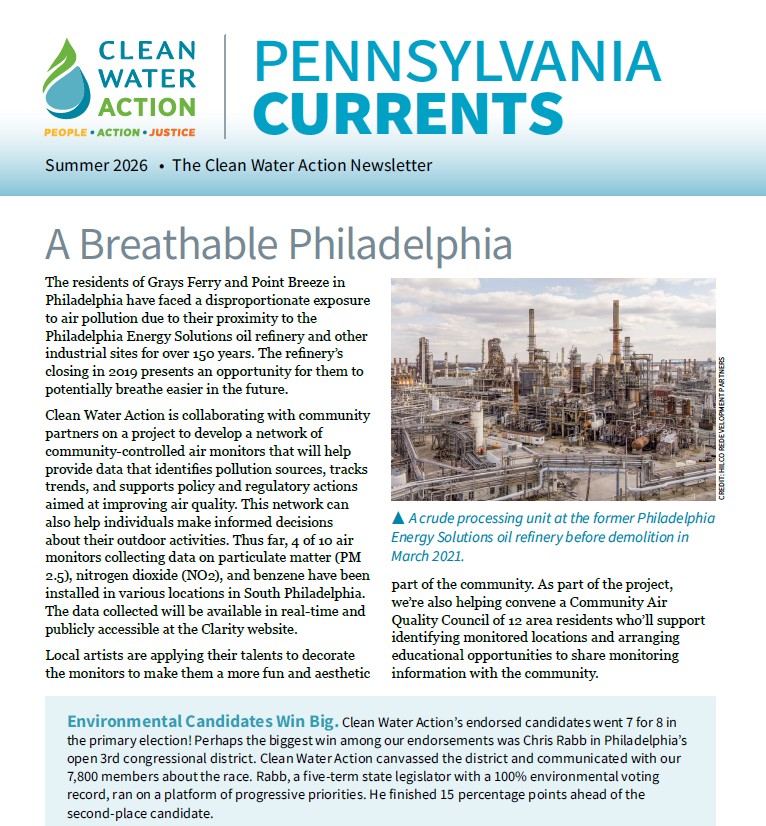
The residents of Grays Ferry and Point Breeze in Philadelphia have faced a disproportionate exposure to air pollution due to their proximity to the Philadelphia Energy Solutions oil refinery and other industrial sites for over 150 years. The refinery’s closing in 2019 presents an opportunity for them to potentially breathe easier in the future.
Clean Water Action is collaborating with community partners on a project to develop a network of community-controlled air monitors that will help provide data that identifies pollution sources, tracks trends, and supports policy and regulatory actions aimed at improving air quality. This network can also help individuals make informed decisions about their outdoor activities. Thus far, 4 of 10 air monitors collecting data on particulate matter (PM 2.5), nitrogen dioxide (NO2), and benzene have been installed in various locations in South Philadelphia. The data collected will be available in real-time and publicly accessible at the Clarity website.
Local artists are applying their talents to decorate the monitors to make them a more fun and aesthetic part of the community. As part of the project, we’re also helping convene a Community Air Quality Council of 12 area residents who’ll support identifying monitored locations and arranging educational opportunities to share monitoring information with the community.
Environmental Candidates Win Big
Clean Water Action’s endorsed candidates went 7 for 8 in the primary election! Perhaps the biggest win among our endorsements was Chris Rabb in Philadelphia’s open 3rd congressional district. Clean Water Action canvassed the district and communicated with our 7,800 members about the race. Rabb, a five-term state legislator with a 100% environmental voting record, ran on a platform of progressive priorities. He finished 15 percentage points ahead of the second-place candidate.
Now it’s on to the higher stakes of the general election where the governor, half the State Senate and all 203 State House seats are up. Control of the State House is currently by just 1 seat, so any of these races could tip the balance.
Becoming Air Aware in Pittsburgh
Clean Water Action recently wrapped up our Air Aware Program, a project that provided a series of trainings for Braddock and North Braddock residents, in southern Allegheny County. These environmental justice communities live in the shadow of U.S. Steel’s Edgar Thomson Steel Mill and because of its pollution face some of the worst air pollution in Allegheny County and some of the highest asthma rates in the country.
To lay the groundwork for the program, Clean Water Action partnered with community non-profit Valley Clean
Air Now to distribute 200 indoor air purifiers to 100 area families. These preliminary events were a perfect segway for why residents should participate in the Air Aware Program and better understand the conditions that make needing an air purifier necessary.
Air Aware was done in collaboration with community non-profit, Greater Valley Community Services, and stretched across three focuses. The “Reading Monitors” section taught residents how to:
- Check and read low-cost PurpleAir sensors that are deployed at people’s homes and the Allegheny County Health Department’s (ACHD) air quality monitors.
- Understand the United States Environmental Protection Agency’s Air Quality Index, whose color system tells you how clean or polluted your outdoor air is and recommends actions you should take to protect yourself depending upon the color.
- Start a personal air log to track air quality and residents’ experiences under those conditions.
- Report an air quality complaint to ACHD.
The “Understanding Environmental Justice” focus taught residents how to:
- Use the Pennsylvania Department of Environmental Protection’s PennEnviroScreen tool which identifies areas of greater environmental justice exposures by analyzing environmental, health, and socioeconomic burdens.
- Understand what factors comprise Braddock and North Braddock being identified as an environmental justice community.
- Compare the factors for Braddock and North Braddock to similarly designated environmental justice communities across Pennsylvania.
The final discipline helped residents:
- Build a 2–3-minute personal story using their Air Starter Log and data from the monitors and environmental justice screening tool.
- Become comfortable with sharing their story in appropriate public forums and inspire others to get involved.
- Build a “communication chain” to alert interested residents when emerging information about bad air quality days are occurring.
At the end of each focus area, participants took a survey to assess their understanding of the information presented. Participants needed to score well on the survey to move onto the next focus area. Upon conclusion of training, participants were issued a certificate of completion, built new skills, and provided with tools that can be utilized right away to take action in their community.
Taking On Data Centers
Pennsylvanians are voicing concerns about how the development and operation of data centers could impact local resources, infrastructure, the electric grid, and our environment.
That is why Clean Water Action continues to push for legislation that protects ALL communities from ALL data centers, like HB 2151 and HB 2246.
Water is used in operations to cool processor chips. Consumption varies based on the size of the facility and differences in cooling technology, though average daily usage is around 300,000-500,000 gallons. Larger data centers, however, can consume up to 5 million gallons per day. Clean Water Action partnered with State Representative Joe Webster (D-Montgomery) and other environmental allies to develop HB 2246, which focuses on data centers’ impact on water resources. It requires companies to report additional information about the water source they intend to use and gives the Pennsylvania Department of Environmental Protection the authority to add requirements to a permit or deny a permit if it finds that there is a reasonably foreseeable adverse risk to the water source or nearby water users.
Local governments, especially smaller ones, are under-resourced and outmatched compared to Big Tech. This makes them vulnerable to developers who could exploit outdated local zoning rules. State Representative Kyle Donahue’s (D-Lackawanna) HB 2151 provides opportunities for stakeholder feedback and public comment and also requires Pennsylvania’s Local Government Commission to create a model ordinance to help those municipalities who want to put in place baseline protections like height and size limits, sound barriers, setback distances from residential zones, landscape buffers, and emergency response planning.
Clean Water Action is proud to share that both bills passed the State House with bipartisan support. Unfortunately, they are currently experiencing a setback due to State Senate Majority Leader Joe Pittman’s (R-Indiana) comments in a recent news story that he isn’t planning on advancing any bills regulating data centers right now. He argued instead that the state should “make sure that we’re competing against our neighboring states.” This can be seen as nothing but a failure of leadership and putting Big Tech’s interests before Pennsylvanians.
Governor Shapiro unveiled the details of the Governor’s Responsible Infrastructure Development (GRID). GRID establishes some best practices in four areas that data centers must comply with to receive financial support from the Commonwealth. GRID sets a floor, but there are missing protections, practices that aren’t as strong as they need to be and flimsy language like “shall commit to” and “good faith efforts.”
This is why we need to keep the pressure on. ACT TODAY to help move and pass HB 2246 and HB 2151.
Making Our Voices Heard in the State Capitol
Clean Water Action held its annual Lobby Day in Harrisburg on June 9th. This was an opportunity for the more than 70 Pennsylvanians who registered to join us to share perspectives about how our community’s health and environment are threatened by the proliferation of data centers, the continued use of toxic PFAS chemicals, and new and expanding industrial air pollution.
Making our voices heard is what democracy looks like and can influence our state legislators to better address these threats, especially in low income and communities of color that are perpetually exposed to hazardous conditions.
The bills we lobbied on were:
- HB 109 which requires polluting facilities seeking to build or expand in an environmental justice community to prepare a cumulative environmental impact assessment and empowers the Pennsylvania Department of Environmental Protection to deny a permit or require added protections if the assessment finds operations would further harm the community.
- HB 1261/SB 980 which eliminates PFAS from firefighting foam. PFAS has been linked to cancer, immune system suppression, liver damage, reduced fertility, and increased risk of thyroid disease.
- HB 2145 which prohibits PFAS in products as well as a pair that provide protections from data centers, HB 2246 and HB 2151.
Toxic Free Products
Pennsylvania is closer to protecting consumers by prohibiting the sale and manufacturing of dental floss, juvenile products, menstrual products, and cosmetics that contain toxic PFAS chemicals. HB 2145 passed the State House along significant bipartisan lines in June. See how your legislator voted here.
Clean Water Action worked closely with Rep. Greg Scott (D-Montgomery) to develop the language for the bill. This comes as studies by the University of Notre Dame found nearly half of the feminine hygiene products and cosmetics they tested contained indicators of PFAS use.
NATIONAL UPDATES
EPA Proposes to Roll Back PFAS Drinking Water Protections
In 2024, the Environmental Protection Agency (EPA) finalized the nation’s first drinking water standards for six toxic PFAS “forever chemicals,” a major victory for public health after years of advocacy. Now, the Trump administration is proposing to rescind protections for PFHxS, PFNA, GenX chemicals, and PFAS mixtures while also creating a pathway for some water systems to delay compliance with the remaining PFOA and PFOS standards until 2031. PFAS contamination has been found in drinking water sources across the country and exposure to these chemicals has been linked to cancer, immune system suppression, developmental harms, and other serious health effects.
Clean Water Action strongly opposes these rollbacks. Communities should not be forced to wait longer for protection from toxic chemicals in their drinking water. Instead of weakening safeguards, EPA should accelerate efforts to prevent PFAS pollution at its source, hold polluters accountable, and strengthen protections for public health. During the public comment period, Clean Water Action is mobilizing members and allies to urge EPA to reject these proposals and maintain strong federal drinking water standards for PFAS. Take action today before the comment period closes July 20, 2026.
Honoring Excellence in Lead Pipe Replacement
On June 23rd, the Lead Service Line Replacement Collaborative recognized 16 people and programs leading the charge to remove lead from the nation’s drinking water systems. During the recognition ceremony, Lynn Thorp, President of Clean Water Action and Lead Services Line Replacement Collaborative Steering Committee member, presented the block of awards related to excellence in community engagement, ensuring equal access to replacement, promoting public health protection, and other aspects of program design that reflect a collaborative approach to getting the job done. Read more here.
EPA’s Latest Giveaway to the Coal Industry
Clean Water Action has worked on securing stronger wastewater limits for coal plants for more than 13 years. In 2024, EPA finalized long-overdue protections to help control the hundreds of millions of pounds of toxic pollution being released by coal plants each year. Yet, in December 2025, EPA extended compliance deadlines by up to five years, prolonging the release of dangerous pollutants into our waterways. Now, in a second giveaway to the coal industry, EPA is proposing to weaken federal wastewater standards at up to 113 coal plants across the country. The proposed rule would threaten drinking water, damage critical ecosystems, and put the health of communities across the country at risk.
During the comment period, we spoke out at meetings with EPA, mobilized thousands of comments urging EPA to withdraw its plans, and coordinated a community comment letter with nearly 65 national, state, and local organizations opposing the rule. Thank you for helping us push back against EPA’s latest giveaway to the coal industry.
Yale Environmental Fellows Program
Our National Campaigns Team is excited to welcome two fellows for the summer from the Yale Environmental Fellows Program and the Yale Conservation Scholars-Early Leadership Initiative: Jagur Parks and Brandi Williams. As part of their first week, they had the opportunity to visit Climate Action Campaign’s unique pop-up, the Museum of Unnatural Disasters. This moving exhibit highlighted how extreme climate events are affecting us all through artifacts and survivor stories.
Juneteenth and Environmental Justice
Juneteenth is a celebration of liberation, resilience, and the ongoing struggle to ensure that the promise of freedom is realized for everyone. As part of our efforts commemorating this important day, we’re proud to highlight the environmental justice work happening across Clean Water Action. Read about it in our latest blog.
CURRENTS is published by Clean Water Action and Clean Water Fund. Reproduction in whole or part is permitted with proper credit. © 2026 All rights reserved.