In this Issue:
- Clean Water Priorities in Maryland's 2026 Legislative Session
- Composting Advocacy
- Protecting Community Health and Voices with the CHERISH Our Communities Act
- Pushing Back Against Plastics Incineration in Howard County
- Bottle Bill Still Possible
- National Updates
Clean Water Priorities in Maryland’s 2026 Legislative Session
This year, Clean Water Action’s Maryland team worked hard on a suite of bills on solid waste management, septic system management, and environmental justice. Facing a difficult financial landscape as Marylanders grappled with the impact of the federal government’s layoffs and funding cuts, environmental priorities from across the sector struggled to gain purchase, and our bills were no exception. 2026 gave us one victory, and many next steps to pursue in the years ahead.
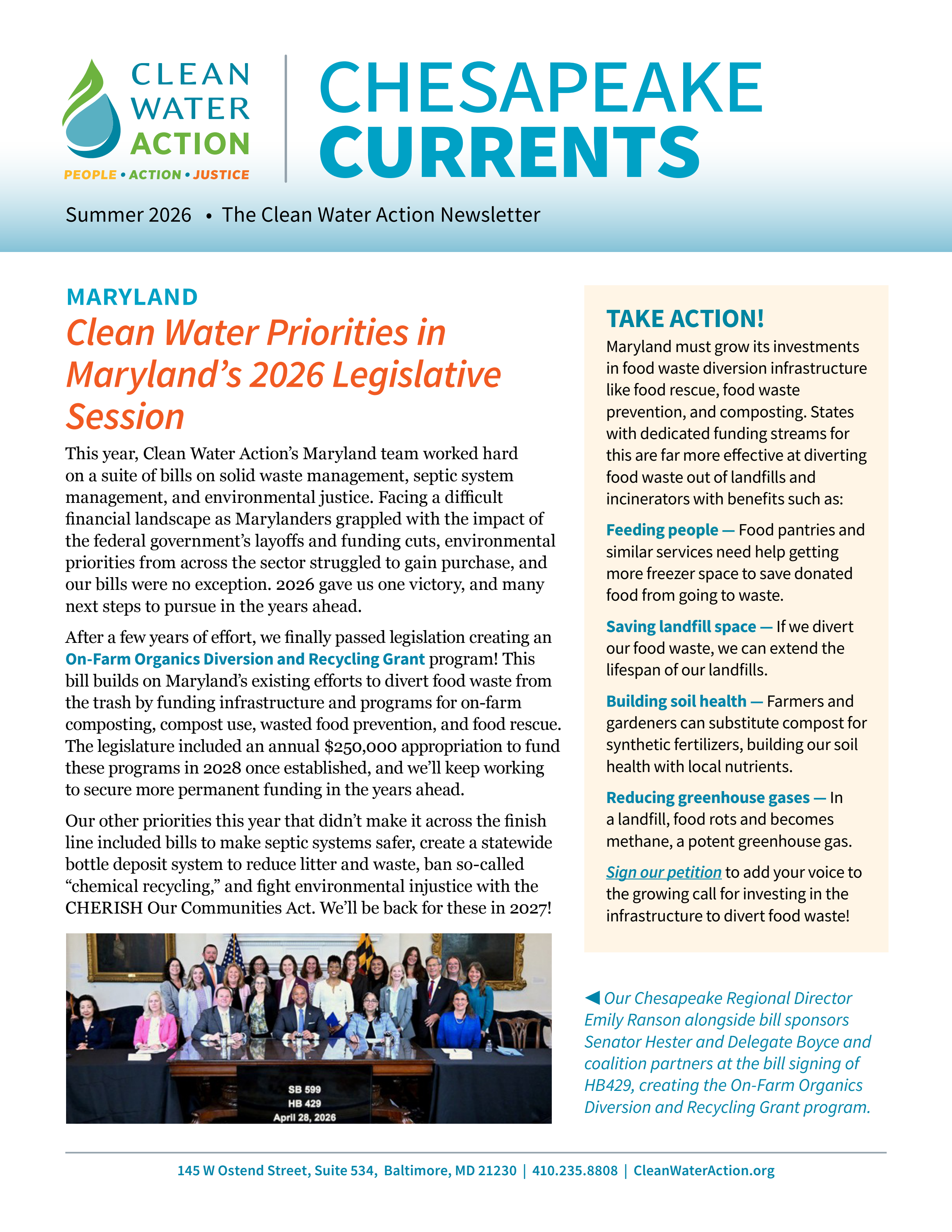
After a few years of effort, we finally passed legislation creating an On-Farm Organics Diversion and Recycling Grant program! This bill builds on Maryland’s existing efforts to divert food waste from the trash by funding infrastructure and programs for on-farm composting, compost use, wasted food prevention, and food rescue. The legislature included an annual $250,000 appropriation to fund these programs in 2028 once established, and we’ll keep working to secure more permanent funding in the years ahead.
Our other priorities this year that didn’t make it across the finish line included bills to make septic systems safer, create a statewide bottle deposit system to reduce litter and waste, ban so-called “chemical recycling,” and fight environmental injustice with the CHERISH Our Communities Act. We’ll be back for these in 2027!
TAKE ACTION!
Maryland must grow its investments in food waste diversion infrastructure like food rescue, food waste prevention, and composting. States with dedicated funding streams for this are far more effective at diverting food waste out of landfills and incinerators with benefits such as:
- Feeding people — Food pantries and similar services need help getting more freezer space to save donated food from going to waste.
- Saving landfill space — If we divert our food waste, we can extend the lifespan of our landfills.
- Building soil health — Farmers and gardeners can substitute compost for synthetic fertilizers, building our soil health with local nutrients.
- Reducing greenhouse gases — In a landfill, food rots and becomes methane, a potent greenhouse gas.
Sign our petition to add your voice to the growing call for investing in the infrastructure to divert food waste!
Composting Advocacy
Clean Water Action, in collaboration with the MD-DC Compost Council Advocacy Committee, is working to strengthen composting infrastructure and community engagement, particularly in Prince George’s and Howard Counties. A key focus of ours is increasing participation in the Prince George’s County Solid Waste Advisory Committee (SWAC), which is vital to shaping local waste-reduction programs.
Recently, SWAC has lost several members, creating a need to recruit new voices, especially people with experience or interest in composting. We want to see greater representation from the composting community to ensure that organics diversion remains a priority within the county’s broader waste management strategy. Both SWAC leadership and our team have identified the need to work more closely with the MD-DC Compost Council to expand participation in composting programs in Prince George’s County.
To support these goals, Clean Water Action has been working on outreach to community partners in Prince George’s and Howard Counties, primarily those involved in curbside compost pickup services. These partnerships are essential for understanding the success of composting programs and identifying opportunities for growth. However, one ongoing challenge is the lack of accessible data on program participation. Currently, there are no readily available figures on how many residents use curbside composting services. To address this gap, we have reached out to county recycling offices in both Prince George’s and Howard Counties to request more information and hopefully improve transparency around program success.
At the policy level, we continue to advocate for improvements to Maryland’s Wasted Food Law. Presently, the law requires large commercial establishments generating at least one ton of food waste per week to divert those organic materials from the trash if they are located within a 30-mile radius of an organics recycling facility. Clean Water Action is working to strengthen these requirements, pushing to lower diversion requirement thresholds to a quarter ton of food waste per week, while also addressing enforcement challenges and capacity limitations.
Furthermore, as part of the MD-DC Compost Council Advocacy Committee, Clean Water Action is also exploring ways to find funding to help businesses meet these diversion requirements. To this end, we have developed a survey for commercial establishments in designated compost collection areas to gather the feedback we need on which aspects of the current law are working. Survey questions include what improvements are needed and if businesses have experienced economic impacts as a result of compliance. This input will help us work with Maryland lawmakers to develop future legislation that is both effective and equitable.
Steady Progress on Compost in Baltimore City
We’ve been working for several years alongside the South Baltimore Community Land Trust to advance composting at the municipal level in Baltimore City, through detailed advocacy work on the city’s annual budget. Last year, we secured $750,000 additional funding in the budget to advance yard waste composting, and this year, we advocated for $3 million to complete construction of the city’s first compost facility. We didn’t secure the $3 million amendment this year, but we did get commitments that the City will fund the project next year and that the delay in funding won’t delay project completion. Learn more here.
Protecting Community Health and Voices with the CHERISH Our Communities Act
As co-facilitators of the Mid-Atlantic Justice Coalition’s Maryland table, we’ve been working for years to advance environmental justice policy in Maryland. Alongside passing the Transportation Equity Act in 2023 and the Reclaim Renewable Energy Act in 2025, the coalition developed the CHERISH Our Communities Act: legislation based on the experiences of frontline environmental justice communities across the state frustrated by holes in Maryland’s system of issuing permits to pollute.
Introduced in the Maryland General Assembly in 2025 and 2026, the CHERISH Our Communities Act is based on best practices from bills already passed in New Jersey, Minnesota, and New York. It centers the experiences of frontline community organizations and allies in Maryland that have worked for years to protect communities from polluting facilities and prevent major polluters from being built in the first place. This legislation gives the Maryland Department of the Environment and the Public Service Commission more information, authority, and requirements to better protect residents who are exposed to disproportionate amounts of pollution.
The CHERISH Our Communities Act also fills big gaps in community participation during the permitting process. Currently, the Maryland Department of the Environment must take public comments and hold public hearings for many types of permits—but some permits that have the biggest impacts on community health aren’t required to take public input, including some types of air pollution and waste disposal permits. In these cases, communities that would be impacted struggle to make their voices heard. For the first time, the CHERISH Act requires a public comment process on these permits, improving the community’s opportunity to shape decisions. And it also enhances consequences for permit violations in protected areas, ensuring that residents receive meaningful recompense for pollution.
Unfortunately polluting industries succeeded in blocking the legislation this year, despite support from the Maryland Community Coalition for the Environment, the Maryland Legislative Black Caucus, the Maryland Legislative Latino Caucus, the Maryland State Council on Cancer Control, the Maryland Commission on Environmental Justice and Sustainable Communities, the League of Women Voters, the Maryland Children’s Environmental Health and Protection Advisory Council — and many more. We’ll keep working with our frontline partners in the Mid-Atlantic Justice Coalition to advance community power and environmental justice in Maryland.
Pushing Back Against Plastics Incineration in Howard County
For the past two years in Howard County, Clean Water Action has supported the work of the Stop Grace Coalition who are pushing back against a pilot plant for plastics incineration owned by W.R. Grace & Co. chemical company. The Coalition is made up of residents of communities near W.R. Grace’s Howard County Headquarters where the company built a so-called “chemical recycling” facility less than a football field away from homes.
The company began operation of this facility on February 25th of this year despite widespread and constant community outcry against it. The Stop Grace Coalition continues to fight to shut down the facility through every means at their disposal, including community pressure and legal action. Clean Water Action is an active partner in their efforts providing advice, technical knowledge and organizing support.
In the coming weeks there will be a permit hearing at the Maryland Department of the Environment (MDE) to decide if W.R. Grace can continue to operate their pyrolysis incinerator indefinitely into the future. Clean Water Action will be there to support the Stop Grace Coalition as they work to mobilize their neighbors and communities to once again tell MDE to protect them from the harmful impacts of pyrolysis incineration and stop Grace’s Pyrolysis pilot plant.
Bottle Bill Still Possible
Maryland’s proposed Bottle Bill, which would establish a 10-cent refundable deposit on beverage containers, would increase recycling rates from 25% to over 90% and significantly reduce litter and plastic pollution. While the bill did not pass during the 2026 legislative session, key committee leaders directed the Maryland Department of the Environment to provide a report by December 2026 outlining the implementation needs and how the bill can align with the state’s new extended producer responsibility program. The legislation has since garnered more support and is being fine-tuned for reintroduction in the 2027 legislative session.
NATIONAL UPDATES
EPA Proposes to Roll Back PFAS Drinking Water Protections
In 2024, the Environmental Protection Agency (EPA) finalized the nation’s first drinking water standards for six toxic PFAS “forever chemicals,” a major victory for public health after years of advocacy. Now, the Trump administration is proposing to rescind protections for PFHxS, PFNA, GenX chemicals, and PFAS mixtures while also creating a pathway for some water systems to delay compliance with the remaining PFOA and PFOS standards until 2031. PFAS contamination has been found in drinking water sources across the country and exposure to these chemicals has been linked to cancer, immune system suppression, developmental harms, and other serious health effects.
Clean Water Action strongly opposes these rollbacks. Communities should not be forced to wait longer for protection from toxic chemicals in their drinking water. Instead of weakening safeguards, EPA should accelerate efforts to prevent PFAS pollution at its source, hold polluters accountable, and strengthen protections for public health. During the public comment period, Clean Water Action is mobilizing members and allies to urge EPA to reject these proposals and maintain strong federal drinking water standards for PFAS. Take action today before the comment period closes July 20, 2026.
Honoring Excellence in Lead Pipe Replacement
On June 23rd, the Lead Service Line Replacement Collaborative recognized 16 people and programs leading the charge to remove lead from the nation’s drinking water systems. During the recognition ceremony, Lynn Thorp, President of Clean Water Action and Lead Services Line Replacement Collaborative Steering Committee member, presented the block of awards related to excellence in community engagement, ensuring equal access to replacement, promoting public health protection, and other aspects of program design that reflect a collaborative approach to getting the job done. Read more here.
EPA’s Latest Giveaway to the Coal Industry
Clean Water Action has worked on securing stronger wastewater limits for coal plants for more than 13 years. In 2024, EPA finalized long-overdue protections to help control the hundreds of millions of pounds of toxic pollution being released by coal plants each year. Yet, in December 2025, EPA extended compliance deadlines by up to five years, prolonging the release of dangerous pollutants into our waterways. Now, in a second giveaway to the coal industry, EPA is proposing to weaken federal wastewater standards at up to 113 coal plants across the country. The proposed rule would threaten drinking water, damage critical ecosystems, and put the health of communities across the country at risk.
During the comment period, we spoke out at meetings with EPA, mobilized thousands of comments urging EPA to withdraw its plans, and coordinated a community comment letter with nearly 65 national, state, and local organizations opposing the rule. Thank you for helping us push back against EPA’s latest giveaway to the coal industry.
Yale Environmental Fellows Program
Our National Campaigns Team is excited to welcome two fellows for the summer from the Yale Environmental Fellows Program and the Yale Conservation Scholars-Early Leadership Initiative: Jagur Parks and Brandi Williams. As part of their first week, they had the opportunity to visit Climate Action Campaign’s unique pop-up, the Museum of Unnatural Disasters. This moving exhibit highlighted how extreme climate events are affecting us all through artifacts and survivor stories.
Juneteenth and Environmental Justice
Juneteenth is a celebration of liberation, resilience, and the ongoing struggle to ensure that the promise of freedom is realized for everyone. As part of our efforts commemorating this important day, we’re proud to highlight the environmental justice work happening across Clean Water Action. Read about it in our latest blog.
CURRENTS is published by Clean Water Action and Clean Water Fund. Reproduction in whole or part is permitted with proper credit. © 2026 All rights reserved.