When people hear about a sewage spill, they often assume it’s an inevitability — a pipe that simply failed one day. Sometimes it is a simple act of bad luck or weather. But more often than you might realize, these breaks are avoidable. When we have proper investment and care for our infrastructure, we can fix these issues before they happen.
The recent spill into the Potomac River was sadly more avoidable than not.
In fact, it reveals two avoidable failures.
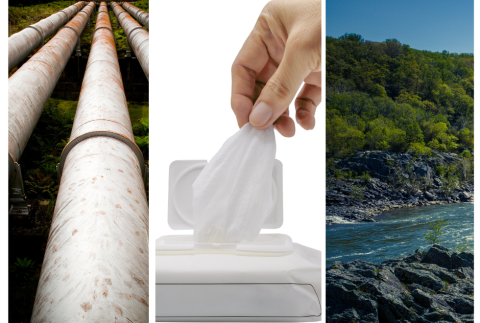
The first was decades in the making: the quiet deterioration of our wastewater infrastructure. The second happened during the cleanup itself: the continued flushing of so-called “flushable” wipes that clogged emergency equipment meant to stop the pollution.
The Potomac spill was the predictable result of underinvestment and preventable damage to the systems that protect our water every day.
The Pipe That Failed Was Part of a Much Bigger Problem
On January 19, a section of the Potomac Interceptor — a 72-inch sewer pipe that carries wastewater from Maryland and Virginia to D.C.’s Blue Plains treatment plant — collapsed near the Clara Barton Parkway. The break sent hundreds of millions of gallons of untreated sewage into the Potomac River, one of the largest sewage spills in recent U.S. history.[1]
Pipes like this carry the waste from our homes and communities every day, usually without anyone noticing. But many of them were installed more than half a century ago. The Potomac Interceptor itself dates back to the 1960s.[2]
Across the country, the same story is playing out underground. Wastewater pipes installed during the middle of the 20th century are reaching the end of their useful lives at roughly the same time. Engineers sometimes refer to this as the “replacement cliff.”
And the scale of the problem is staggering. The Environmental Protection Agency estimates the United States needs hundreds of billions of dollars in investment to modernize aging water infrastructure over the coming decades.[3]
Upgrading the nation’s infrastructure is no small feat. Where the financial obligation lies in the replacement of the Potomac interceptor is tricky, and would largely be paid by ratepayers, but the country as a whole has a great tool for assisting local communities in repairs already. The State Revolving Funds (SRFs), the nation’s small interest loan programs for funding wastewater and drinking water upgrades.
In 2021, Congress made a historic investment through the Bipartisan Infrastructure Investment and Jobs Act (IIJA), which significantly increased funding for water infrastructure projects. Communities across the country have been using those funds to repair pipes, modernize treatment plants, and prevent exactly the kind of failures we saw in the Potomac.
But those increased investments are temporary.
The additional IIJA funding that helped jump-start long-overdue projects is scheduled to end in September, even though the infrastructure challenges it was designed to address will last for decades.
That leaves a massive funding gap between the work we know must be done and the resources available to do it.
Events like the Potomac spill are reminders of what happens when that gap persists. There is no need to “Turn the tap off” on those funds until the job is done. As Clean Water Action outlined in our Putting Drinking Water First paper last year.[4]
The Cleanup Was Made Worse by Something We Shouldn’t Flush
Even after the pipe collapsed, there was still a chance to limit the damage.
Crews installed a system of powerful temporary pumps designed to divert wastewater around the damaged section of pipe. The system was meant to reduce the amount of sewage reaching the river while repairs were underway.
But the emergency pumps ran into a familiar problem.
They clogged.
The culprit was a mass of wipes flushed into the sewer system. Even products labeled “flushable” behave very differently from toilet paper once they enter wastewater infrastructure. Instead of breaking apart quickly, they remain intact, tangle together, and wrap around pumps and mechanical equipment.
Across the country, wipes are already costing wastewater utilities hundreds of millions of dollars in additional operating costs each year.
When they jam pumps during an emergency response, the consequences can be even greater.
In other words, a crisis caused by aging infrastructure was made worse by a consumer product that should never have been flushed in the first place.
So Why are “Flushable” Wipes Labeled as “Flushable”?
Why are “flushable” wipes labeled as “flushable”? Because that sells better. Those products are labeled that way because the companies are allowed to lie about it.
There is a straightforward policy solution that could help prevent this problem.
The bipartisan “The Wastewater Infrastructure Pollution Prevention and Environmental Safety Act” (WIPPES) would require clear and prominent “Do Not Flush” labeling on wipes that are not designed to break down in sewer systems.[5]
It’s a clear idea: if wipes can damage pipes, pumps, and treatment equipment, consumers should be clearly warned not to flush them.
The legislation has drawn bipartisan support from wastewater utilities across the country. This is because the workers who maintain these systems see this problem every day. These wipes destroy pipes and unnecessarily clog systems.
Maryland considered a similar policy in 2017, but the proposal went nowhere, further pointing to how avoidable and known this issue is.
Better labeling alone won’t solve every clog in America’s sewer system. But it’s an important step toward reducing damage to infrastructure that communities rely on to protect public health and our waterways.
Preventable Problems
The Potomac River deserved better than a spill that was avoidable twice.
First, we need to continue investing in the infrastructure that keeps sewage out of our rivers. The progress made through the Clean Water State Revolving Fund and the IIJA cannot stop just because a funding window closes. The work is far from finished.
Second, we need common-sense policies that prevent unnecessary damage to those systems. This includes clear rules about products that should never be flushed.
Our wastewater systems work quietly beneath our feet every day. When they function well, we hardly think about them at all.
But when they fail, the consequences are visible in our rivers.
The lesson from the Potomac spill should be clear: how willing we are to invest in the infrastructure that protects our water? And how willing we are to stop damaging it in easily preventable ways?
[1] https://mde.maryland.gov/programs/water/Compliance/Pages/Potomac-Interceptor-Sewer-Overflow.aspx
[4] https://cleanwater.org/publications/pdwf-water-infrastructure
[5] https://www.congress.gov/bill/119th-congress/house-bill/2269