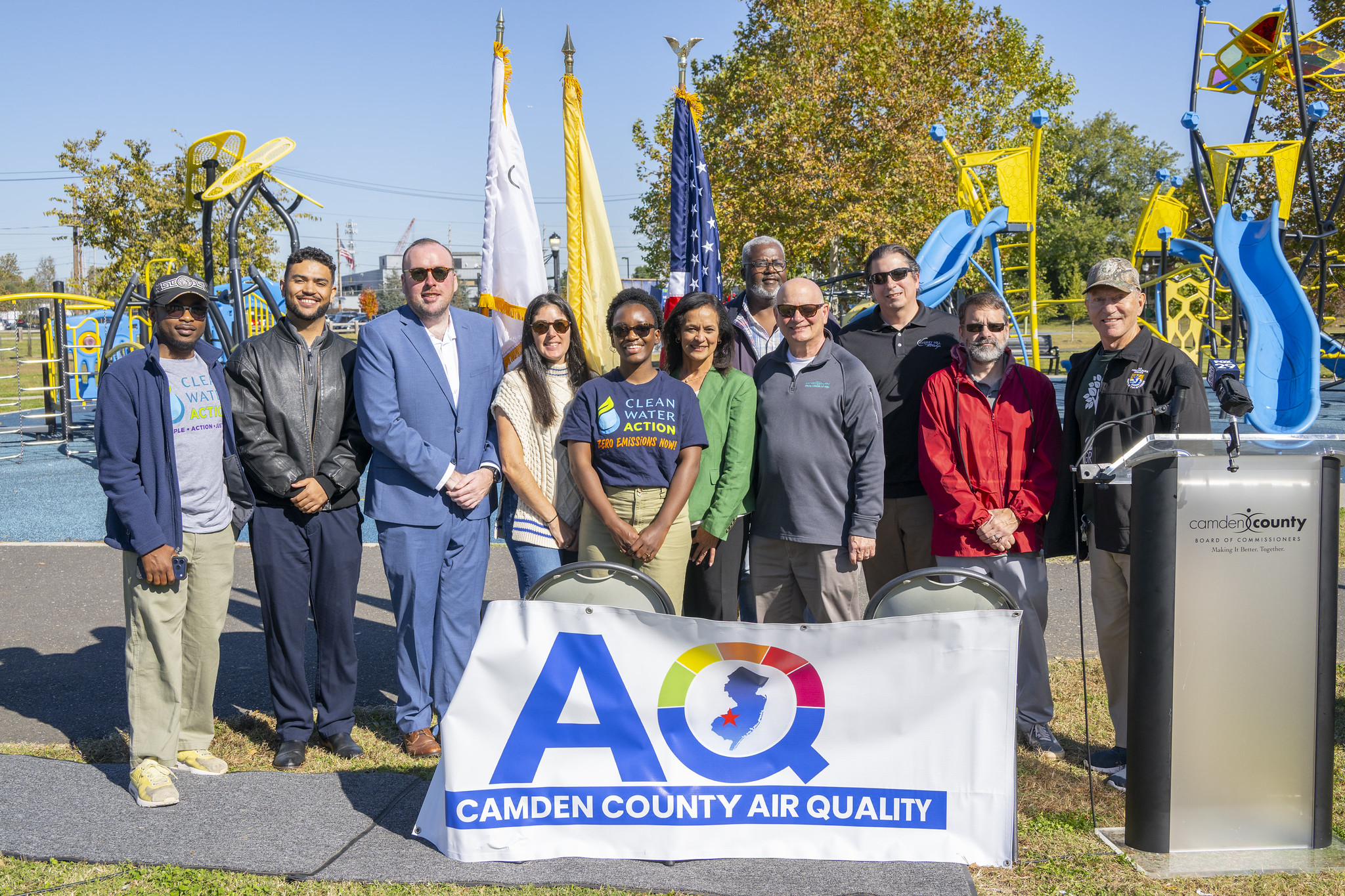
[Camden NJ (10/26/2026] – Today, dozens of community & environmental advocates and local government leaders gathered in Camden to measure the levels of air pollution from diesel trucks on major transit routes and close to areas like schools, community centers, and places of worship to call on leaders of of all levels to support both local and statewide policy to regulate diesel truck pollution in NJ.
This event spotlighted the link between diesel truck pollution and health while calling for strong clean air policies in New Jersey, the most highway-dense state in the country. Although medium- and heavy-duty vehicles make up less than 10% of road traffic, they generate nearly 50% of all toxic tailpipe emissions. The state ranks second nationwide in cancer risk from diesel soot, with over 330 premature deaths and $3.75 billion in monetized health damages attributed to diesel exhaust exposure in 2023.
“Truck counting data is an advocacy tool that helps both community members, advocates and local officials better understand the state of air quality in impacted communities and what needs to be done to regulate that. The truck count data collected today from Camden and other neighboring towns across South Jersey should be a wake up call and also a top priority to support zero emissions solutions and air pollution reduction initiatives in the communities that need it the most. Clean air is a human right and should be compromised for the sake of profit.” - Tolani Taylor, Zero Emissions & Warehouse Organizer, Clean Water Action.
Underscoring the urgent need to address diesel truck pollution and protect public health across New Jersey, advocates from Clean Water Action, Camden County Air Quality Committee, Camden for Clean Air, Rutgers University Environmental Studies, Cherry Hill Green Team and Environmental Board, Strong Towns, and other community advocacy organizations joined Camden County Commissioner Jeff Nash, Camden City Councilmembers Barclay and Fuentes, and Cherry Hill Councilmember Doshi, Assemblyman Singh’s office, and the Collingswood Mayor Solano Ward and Barrington Mayor Hanson in a coordinated regional effort to count truck traffic, monitor air quality, and engage local communities in raising awareness about the impacts of diesel emissions on public health and the environment.
Truck count participants used air monitors-both Atmotube air monitors and Air Gradient air monitors, to measure the levels of particulate matter (PM 2.5) – a harmful pollutant emitted by medium & heavy duty diesel trucks that can penetrate deep into the lungs and bloodstream – around Camden and other neighboring towns like Collingswood, Cherry Hill and Burlington homes, schools, businesses and pedestrian walkways. Participants documented a staggering total of 409 medium- and heavy-duty trucks passing through in the following areas over a 1 hour period:
Air monitors used while performing truck counts at Camden locations.
CAMDEN LOCATIONS:
- 42 trucks counted at intersection of Davis Street & Ferry Ave, near Ferry Senior Apartments)
- 23 trucks counted intersection of East State Street & Wayne Ave, near Mastery Cramer School
- 67 trucks counted at intersection of S 3rd Street & Atlantic Ave, near New Beginnings Ministry of Christ
COLLINGSWOOD LOCATION:
- 199 trucks counted at intersection of US 130 & White Horse Pike
CHERRY HILL LOCATION:
- 45 trucks counted at intersection of Rt 70 & Mercer Street
- 31 trucks counted at intersection of Haddonfield Road & Grove Street 54 at Rt. 70
BURLINGTON LOCATION:
- 2 trucks counted at 403 Neck Road
The truck count occurred approximately at 12pm and 1pm. This volume of diesel traffic in such a short period, concentrated in densely populated neighborhoods, highlights the scale of exposure residents face daily.
Participating in this event also is about shedding light on future local policy solutions like the passage of Kids Clean Air Zone local ordinances. This local policy solution would establish the re-routing of trucks via local ordinances, thereby diverting medium and heavy duty diesel trucks away from sensitive areas like schools, community centers and residential areas. In addition to passage of statewide policy solutions, like the NJ ISR (Indirect Source Review) Bill , both of these solutions will help in efforts to curb diesel pollution at ports, warehouses and other truck attracting facilities over time.
Camden and surrounding South Jersey communities have faced longstanding air quality challenges due to the concentration of industrial facilities, warehouses, major transportation corridors, and proximity to ports. For generations, many of these communities have experienced a disproportionate burden of air pollution, raising serious concerns about public health and environmental justice.
Diesel truck emissions contribute to both local air pollution and climate change, further underscoring the need for effective solutions. Addressing these challenges requires coordinated action at both the local and state levels, including policies that reduce diesel emissions, promote cleaner transportation, and protect residents living near heavily traveled truck routes.
Through today's collaborative effort, participating elected officials, environmental organizations, and community advocates emphasized the importance of advancing practical, achievable solutions that improve air quality, protect public health, promote environmental justice, and support a cleaner, healthier future for communities throughout South Jersey.
“Diesel truck pollution is a serious public health concern, particularly for residents and children living near highways, warehouses, ports, and heavily traveled truck routes. Through the Camden County Air Quality Committee's partnership with Clean Water Action, we are bringing together elected officials, community organizations, and residents across South Jersey to better understand the impact of diesel traffic on our communities. By combining truck count data with real-time air quality monitoring, we can identify areas of concern, raise public awareness, and advocate for meaningful policy solutions. Our goal is to turn this data into action that reduces harmful emissions, protects vulnerable communities, and ensures cleaner, healthier air for everyone.” - Sangeeta Doshi, Program Director, Camden County Air Quality Committee, Cherry Hill Councilmember.
"The primary driver of poor air quality in Camden County, New Jersey, is ground-level ozone pollution. Mobile sources like heavy-duty trucks are big emitters of O₃. Considering that you can't fix what you can't measure, we support the efforts of the Camden County Air Quality Committee, Clean Water Action and all of our community partners in this effort to bring awareness to the sheer volume of these heavy-duty truck crisscrossing our region on a daily basis, so that we can collectively work on solutions including the widespread adoption of zero-emission vehicles." - Sean Mohen, Executive Director, Tri-County Sustainability (Burlington, Camden, Gloucester)
“The South Jersey Truck Count gives us an opportunity to better understand where truck traffic and diesel emissions are affecting our communities. By collecting data in the places where people live, work, and play, we can better understand the challenges facing our residents and work together on practical solutions that can improve air quality across Camden County and South Jersey.” - Jeff Nash, Camden County Commissioner
“As Mayor of Barrington, where both Interstate 295 and the New Jersey Turnpike run through our community, along with significant truck traffic on local roads like the White Horse Pike, Clements Bridge Road, and Gloucester Pike, I know firsthand the impact heavy truck traffic can have on our neighborhoods. While these transportation corridors are essential to our regional economy, we cannot ignore their impact on the air our residents breathe every day. I firmly believe we can support economic growth while also protecting public health and our environment. Initiatives like today's truck count provide valuable data that can help us develop practical solutions to reduce harmful emissions and better protect our communities. I'm proud to stand alongside Commissioner Nash, my fellow elected officials, and representatives from organizations like Clean Water Action and the Camden County Air Quality Committee, who share the belief that clean air shouldn't be a luxury determined by your ZIP code. It should be something every resident, in every community, can count on. Together, we can continue working toward a cleaner, healthier future for all of South Jersey.” - Kyle Hanson, Mayor of Barrington
“Families should not have to worry about the air their children breathe simply because they live near a heavily traveled truck route or a major industrial facility. Today’s collaborative effort brought together by Clean Water Action and Camden County Air Quality Committee reinforces the urgent need to address these longstanding environmental challenges and ensure that every community has access to clean, healthy air.” - Cameron Dockery,Chief of Staff for the Office of Assemblyman Balvir Singh
About Clean Water Action
Clean Water Action is an advocacy organization working to protect the environment, health, economic well-being and community quality of life by organizing strong grassroots coalitions and campaigns to elect environmental candidates and solve environmental and community problems in New Jersey. Clean Water Action is a member of the Coalition for Healthy Ports.
The Coalition for Healthy Ports (CHP) is a broad-based coalition of environmental justice, labor, faith, community, and environmental organizations in NY/NJ working to improve the air quality and health of communities and workers, as well as to ensure that environmental justice is achieved in affected communities.
About the Camden County Air Quality Committee
Established in 2024 to address ongoing air quality challenges in the region, the Camden County Air Quality Committee (CC-AQ) brings together environmental experts, public health professionals, government leaders, and community advocates. The Committee was formed to provide strategic guidance and recommendations to the Camden County Board of Commissioners, municipalities, and regional partners to improve the health of residents and visitors by reducing harmful air pollutants.
Through collaborative partnerships, community air monitoring, education, and public initiatives, the Committee promotes cleaner transportation, advances emission reduction strategies, and supports practical solutions to improve air quality and protect public health throughout Camden County and the surrounding South Jersey region.