Data Centers in Minnesota:
When is “enough,” enough?
Large-scale, or “hyperscale,” data centers are mammoth facilities which house racks and racks of computer servers used for a variety of computing purposes, most notably cloud storage and artificial intelligence (AI) applications. On average, these facilities are 100,000 square feet in size and can exceed 1 million square feet; for reference, the average Costco is 140,000 square feet.
While Clean Water Action Minnesota is not inherently opposed to large-scale data centers, nor the technological advancements of the 21st century, Clean Water Action Minnesota is opposed to massive tax breaks for the ultra-wealthy, exorbitant facility water and energy demands, and threatening our environment for short-term profits.
Here’s the status quo: on June 14th, 2025, Governor Walz signed a whole host of bills to complete the state’s budget bill package. One of those bills was SF19/HF16, which created environmental and energy requirements for data centers and modified sales and use tax exemptions. Within this bill is expanding the definition of “qualified data centers” to include these large-scale data centers and extending the state’s sales tax break from the year 2042 to 2077 for data center purchases of computers, servers, software, and cooling & energy equipment. The bill also revokes the sales tax exemption on electricity bills, which are enormous because of data center energy requirements.
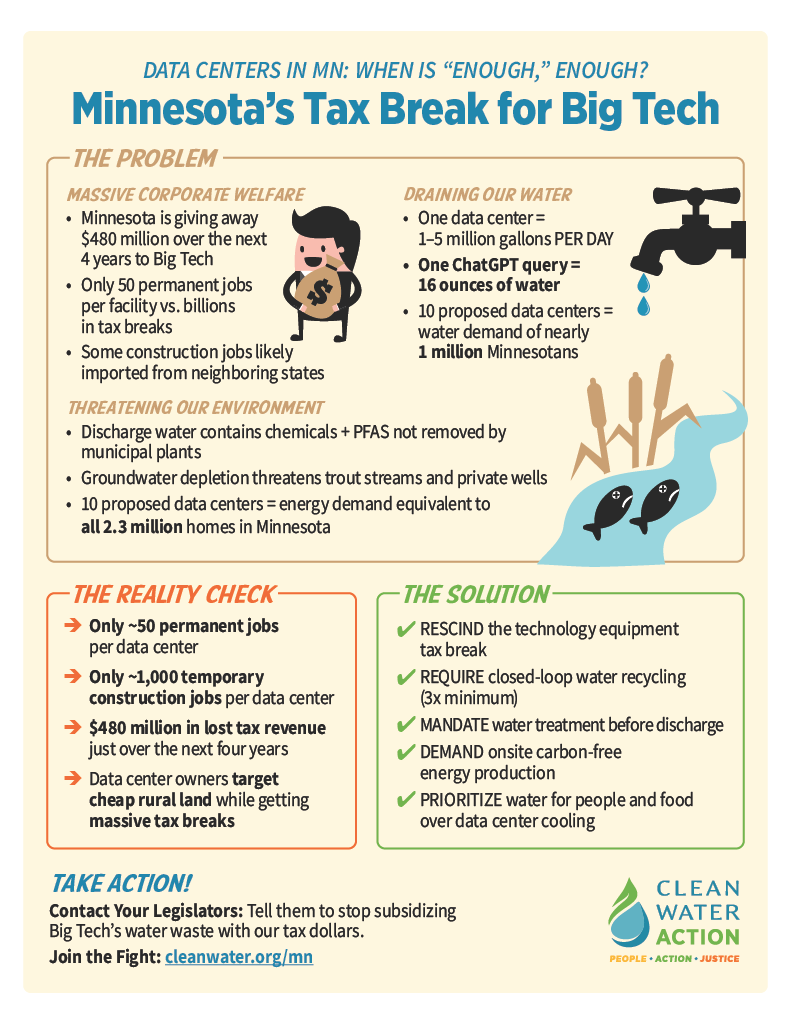
What the electricity sales tax amounts to is the state recouping nearly $140 million in electricity sales tax revenue over the next four years. Which sounds great, except for the fact that the state is poised to miss out on nearly $620 million over that same period in sales tax revenue on all those equipment exemptions. As such, when all is said and done, Minnesota will be losing $480 million over the next four years that we could have otherwise had available to invest in our aging and ailing roads, bridges, and water infrastructure; or to invest in our free school meals program; or to invest in climate change preparedness and mitigation strategies; or to invest in health care to avoid kicking thousands of vulnerable Minnesotans to the curb.
Proponents of hyperscale data centers tell us that these facilities will bring jobs and money (via income and property taxes) to our state. While true, we need a reality check: roughly 1000 construction jobs may be created per facility, the International Brotherhood of Electrical Workers lobbyist testified that some of those jobs will likely need to be imported from neighboring states if there are multiple construction projects at the same time – meaning all that money we pay to those out-of-state workers leaves across our borders when construction is done. Income tax will be paid on those payments as work was done in Minnesota, but that’s the only cut we’ll get from that pool of money. Further, Amazon Web Services’ (AWS) lobbyist testified that their data centers only create 50 long-term jobs, albeit high-paying jobs. Finally, given the sheer square footage required for these facilities, we’re seeing the traditional industry tactic of targeting the lowest-cost rural lands to minimize their acquisition expenses. While these facilities may eventually generate property tax revenue, the extensive tax exemptions we’re providing far exceed what can be recouped through property taxes alone.
Aside from the appalling corporate welfare, there are significant concerns surrounding large-scale data centers’ energy and water demands.
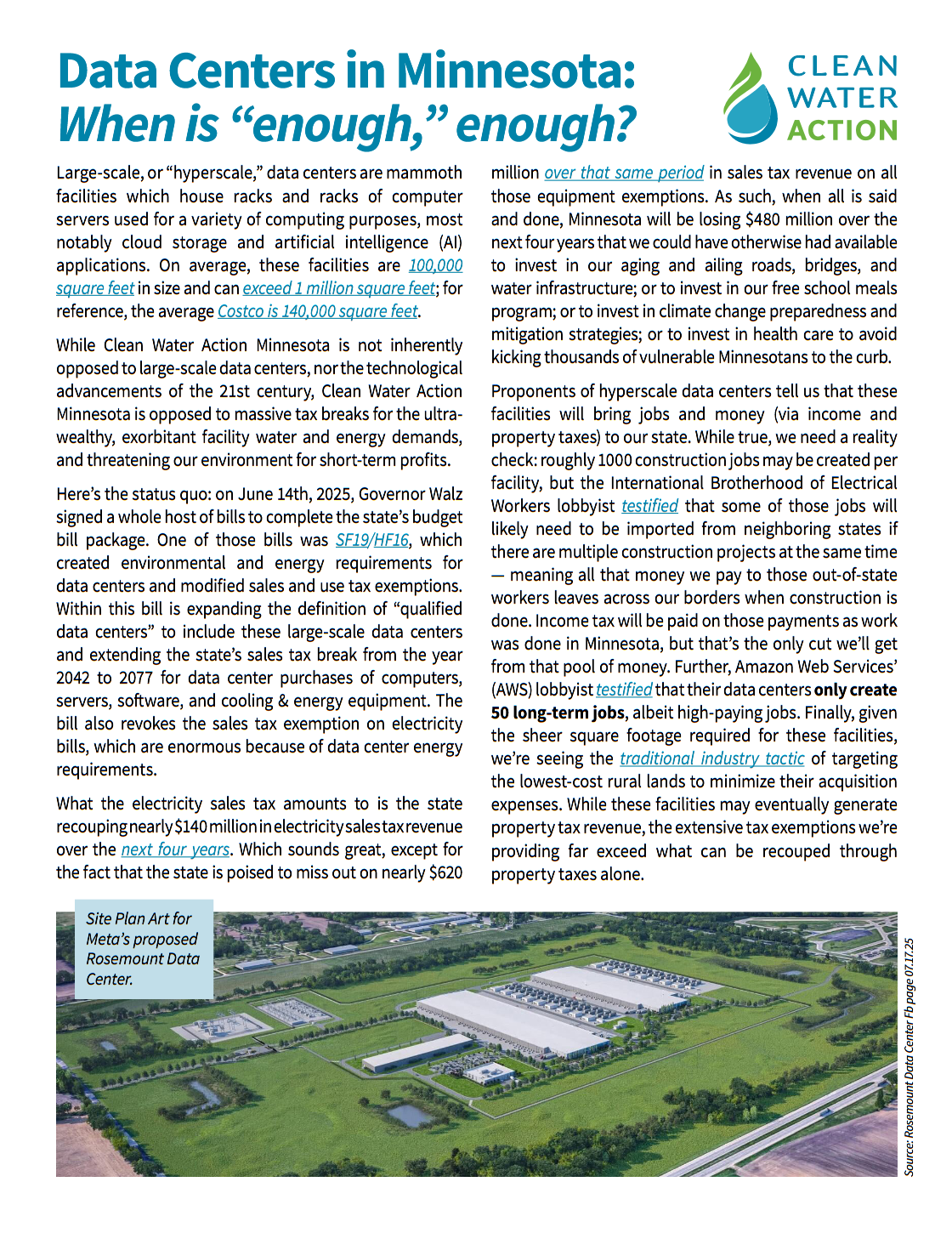
- As has been proposed, Minnesota could soon be host to ten large-scale data centers. These 10 data centers could require as much energy demand as all 2.3 million homes in the entire state. Meta already has one of these facilities under construction in Rosemount.
- One data center can use one million to five million gallons of water per day. According to MN Department of Natural Resources (DNR), the average Minnesotan uses 52 gallons of water per day. This equates to one data center using as much water per day as 20,000-95,000 Minnesotans. To put that in perspective, in 2023 the population of Duluth was 87,680, and the entirety of Fillmore County was 21,522. Further, there are only 12 counties in Minnesota with over 100,000 people, meaning that one data center could use as much water in a day as any one of our other 75 counties.
- According to ChatGPT itself, one chat query uses 16 ounces of water.
- Water used for cooling equipment in these data centers first needs to be clean and drinkable, but is then treated with anti-corrosive chemicals, on top of fluorinated gases (F-gases, a type of PFAS) being used for equipment air cooling. This water is then discharged toward taxpayer-funded municipal treatment facilities, frequently containing pollutants not normally targeted for removal by those facilities and places additional burdens on our water infrastructure.
We know what’s wrong with corporate welfare and the environmental degradation caused by large-scale data centers. Fortunately, we also know solutions to make this a more equitable situation which benefits Minnesotans, not corporations.
- Rescind the sales tax breaks given to large-scale data centers for computer equipment purchases. We cannot put ourselves in a position to lose almost $500 million in revenue.
- Require all data centers to have a closed-loop water cooling system which recycles water at least three times throughout the entire facility before discharge.
- Require water be treated/cleaned prior to discharge. We cannot allow polluters to burden our existing systems while simultaneously requiring we pay for infrastructure improvements via our tax dollars.
- Require onsite carbon-free energy production for data centers. If we must host these facilities, the facility owners need to figure out how to power them, not strain our energy grid for their energy-sucking needs.
- More robust priority demand plans must be implemented to ensure real humans and farmlands get water before data centers, especially in drought conditions.
- Require facilities to track and monitor their water and energy usage to minimize overall strain on our existing infrastructure and resources, and to optimize their systems for maximum efficiency. Only 51% of data center operators track their water usage, and only 10% track water usage across all owned sites.
Now is not the time for further capitulation to monied interests and corporate greed.
Join us in defending our communities and finite natural resources to ensure that Minnesotans are always the priority in our laws and legislature.