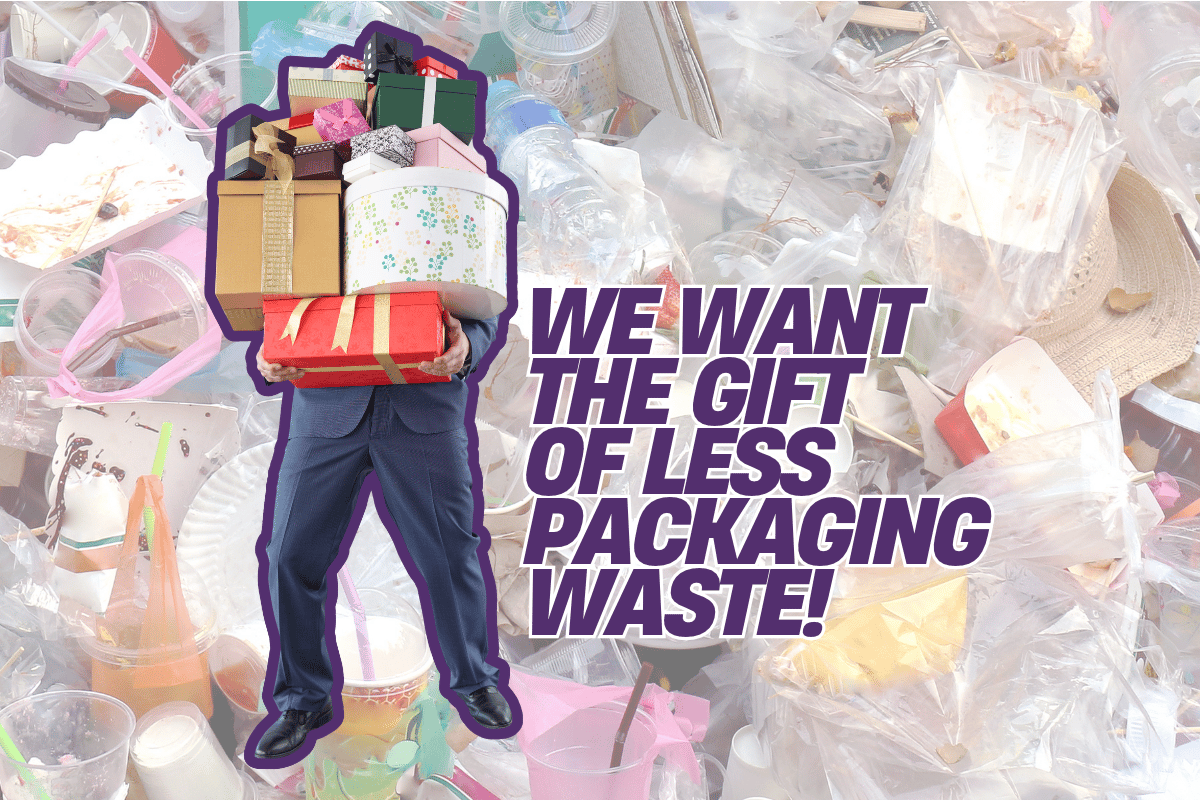
The holidays are here! The day after Thanksgiving kicks off an absolute bender of consumption from gifts to decor to fast fashion. Here's a stat. According to the Center for Biological Diversity, Americans generate 5.8 million more tons of waste in December than in other months.
But hold on. The waste generated by holiday generosity isn't simply the fault of consumers, and it isn't something we can completely solve through individual choices alone. Picture the mountain of molded plastic foam and layers of plastic bags inside many boxes. And who among us hasn't sliced a finger attempting to pry open a plastic clamshell to reach the toy truck inside? Americans deserve policies that require producers to reduce their packaging waste!
Good news! This policy already exists! It's called Extended Producer Responsibility (EPR), and it's already in place across the European Union, Canada, Japan, and many other countries. A handful of states across the U.S. have adopted this policy too!
Here's how it works: Anyone who sells a product on the market is a "producer." Producers have to meet certain sustainability benchmarks for their product packaging to be allowed to enter the market. To organize this, countries have established Producer Responsibility Organizations (PROs) who collect fees from producers to be used to fund improvements to recycling programs and enforce market standards for improved packaging recyclability. For example, in the E.U., all product packaging must be designed for recycling, with a bare minimum of at least 70% of that packaging actually being recycled. EPR can also be a vehicle for reducing toxics in packaging. The E.U. EPR program mandates that food packaging may not contain per- and polyfluoroalkyl substances (PFAS) by the year 2030.
Now, American states struggling to find places to put growing mountains of plastic trash are creating EPR programs too. Oregon and Colorado are well on their way with active programs with other states close behind.
In California, our local Clean Water Action team just celebrated the finalization of a sweeping new EPR policy this year, the Plastic Pollution Prevention and Packaging Producer Responsibility Act. By 2032, 100% of single-use packaging and single-use plastic food ware sold in California must be recyclable or compostable, and 65% of this waste stream must actually be recycled. Producers pay a fee to the new PRO there who will enact policies to hit these mandated targets. Instead of local taxpayers and municipalities paying to haul piles of unwanted packaging, producers in California are funding the program to reduce waste in the first place.
Clean Water Action organizers are working to pass EPR policies in other states too! Our Rhode Island team just attended hearings on a study of a deposit return system for beverage containers (bottle bill) combined with EPR for the Ocean State, and our New Jersey team is also advocating for EPR as rising waste disposal costs eat away at municipal budgets there.
Not all EPR proposals are equal. Clean Water Action strongly advocates for policies that include REUSE targets, not just recycling. Additionally, waste-management EPR alone doesn’t address toxic chemicals in products such as heavy metals and PFAS. The best EPR policies do both. That’s why having advocates and experts like Clean Water Action at the table ensures the best legislation possible to reduce waste and safeguard public health.
The holiday hangover of packaging trash is not inevitable. Yes, we can all make individual choices to reduce waste, but we also need to get to the root of this problem using collective action. EPR policies can force producers to make packaging that can actually be recycled over and over, a step closer to a real Zero Waste economy. Now that's a gift we can't wait to open!
Want to help? Renew your Clean Water Action membership. (Or join for the first time!) When we raise our voices together, we can build new reuse systems while fighting to hold producers accountable for the waste they generate. Stand with us!


