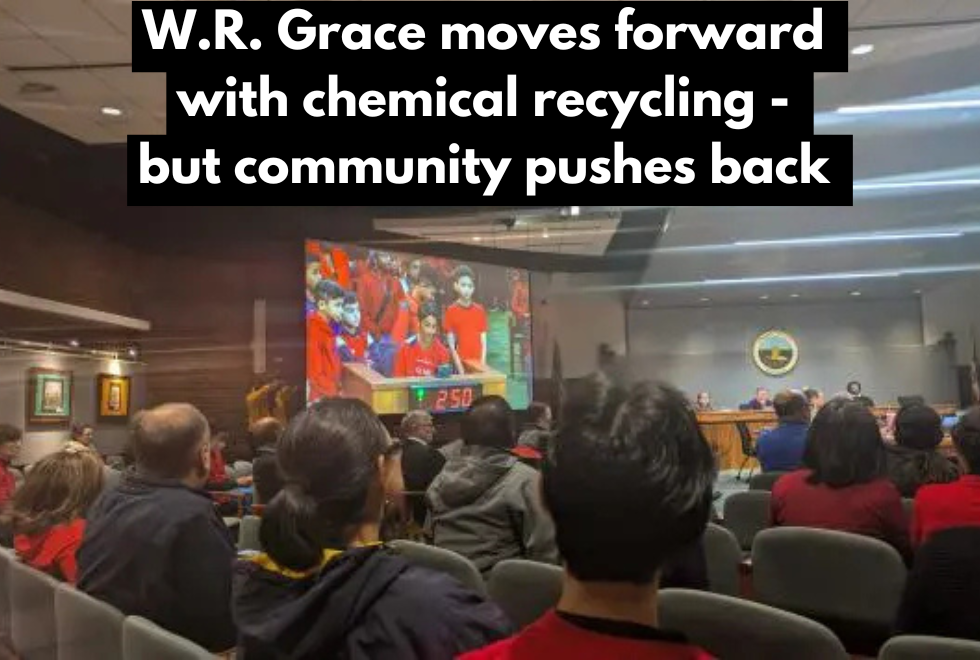
In Howard County, the Cedar Creek community’s fight to prevent W.R. Grace and Co. from constructing a pilot chemical recycling project 230 feet from neighbors’ homes has seen two major developments.
- The bad: on June 19th the Maryland Department of the Environment approved Grace’s air permit to construct their facility.
- The good: on June 30th the Howard County Hearing Examiner reversed and remanded the county’s Department of Planning and Zoning approval of Grace’s zoning permit.
What you can do about it: Join the community action on Tuesday, July 22nd, 4:30-6:00 p.m. at the George Howard Building in Ellicott City, Maryland. RSVP here.
About Chemical Recycling:
Chemical recycling is a catchall term for processes that break down plastic into fuel or plastic feedstock. In this case, W.R. Grace, a major multinational chemical company with headquarters in Howard County, is pushing to construct a pilot project that will create fuel from plastic feedstock.
The process is toxic and risky. At best chemical recycling produces more greenhouse gas emissions than even creating new plastic with added dangers because the process involves incinerating plastic which can release numerous toxic substances including volatile organic compounds, dioxins, heavy metals, and in some cases even PFAS which are extremely hazardous to human health. Beyond these health risks chemical recycling facilities represent meaningful physical risks as well. Because these processes involve high heat and pressure spills, fires and explosions are of meaningful concern. In fact, they are troublingly common. An analysis from Beyond Plastics in 2023 reported fires at the not yet fully operational facility in Brightmark, Indiana in July 2020 and May 2021 and four different fires at the New Hope pyrolysis plant in Tyler, Texas since 2020.
About MDE’s Air Permit Approval:
The Maryland Department of the Environment took some of the community's concerns into consideration when they issued the project its air permit but fell short of protecting the neighborhood. MDE is requiring some additional testing in the form of two one-time emission tests and sample testing of the plastic they will be incinerating for PFAS before it is used. However, ultimately MDE is trusting W.R. Grace’s claims about the safety of their process, and allowing risky toxic research to take place near residents’ homes.
Something the residents asked for early on in the process was a buffer zone between the site and their homes. Buffer zones are considered a best practice for potentially dangerous processes such as chemical recycling – they reduce the safety hazard posed to neighbors and decrease conflict. This effort was unsuccessful.
The Cedar Creek community is currently in the process of perusing a request for judicial review of this permit given the risks to their homes and families it poses.
About the Howard County Hearing Examiner Decision:
The Cedar Creek neighborhood and its fight against having a new, toxic process next door is a clear example why zoning needs to be done carefully and with an eye to the future. The land their neighborhood is built on was originally owned by WR Grace. It was once a forested buffer separating WR Grace’s campus and the next nearest neighborhood. The original zoning was commercial, not single family and attached homes. WR Grace and the developer petitioned the county to rezone the land for more dense, residential use. The company asserted that residential use would not be in conflict with the activities in their facility.
This new pilot project was pushed through the zoning approval process using what amounts to a loophole. Research and development is a “nonconforming” use for the type of zoning the Grace campus exists within. This means that research and development is not explicitly included as an activity within their zoning, but is, ironically, still an allowed activity. Because WR Grace has performed different types of research and development, the county is allowing them to embark on new, riskier projects that require air permits for toxic releases. In effect, because this research was deemed “nonconforming” the Department of Planning and Zoning (DPZ) approved Grace’s new permit with very little research into the risks it poses and there would be very little oversight going forward.
Fortunately, the community was able to appeal this zoning approval to the Howard County Hearing Examiner who ruled in their favor. Specifically the Examiner found that DPZ’s investigation was legally insufficient, and that it relied only on W.R. Grace’s self-classification of its permitted zoning uses without meaningful scrutiny. Furthermore they found that the proposed plastic pyrolysis plant may not qualify as a legal nonconforming use given its zoning status, raising questions about its zoning compliance.
Because of this insufficient effort from DPZ the examiner reversed the zoning approval, froze any work being done on the project, and remanded the decision back to DPZ for thorough review of the permit application.
The Fight Goes on:
The Cedar Creek community is celebrating the win on the county level but the fight goes on. The community has issued a CALL TO ACTION to rally in support of the Hearing Examiner's Decision and to support their petition for Judicial Review of the MDE Air Permit Approval. They will be coming together on Tuesday, July 22nd, 4:30-6:00 p.m. at the George Howard Building in Ellicott City, Maryland (3430 Court House Dr #100, Ellicott City, MD 21043). Join us in supporting the community!


