Filter By:
Type
Posted On
Search Results
Berkeley Unified School District: Phase One
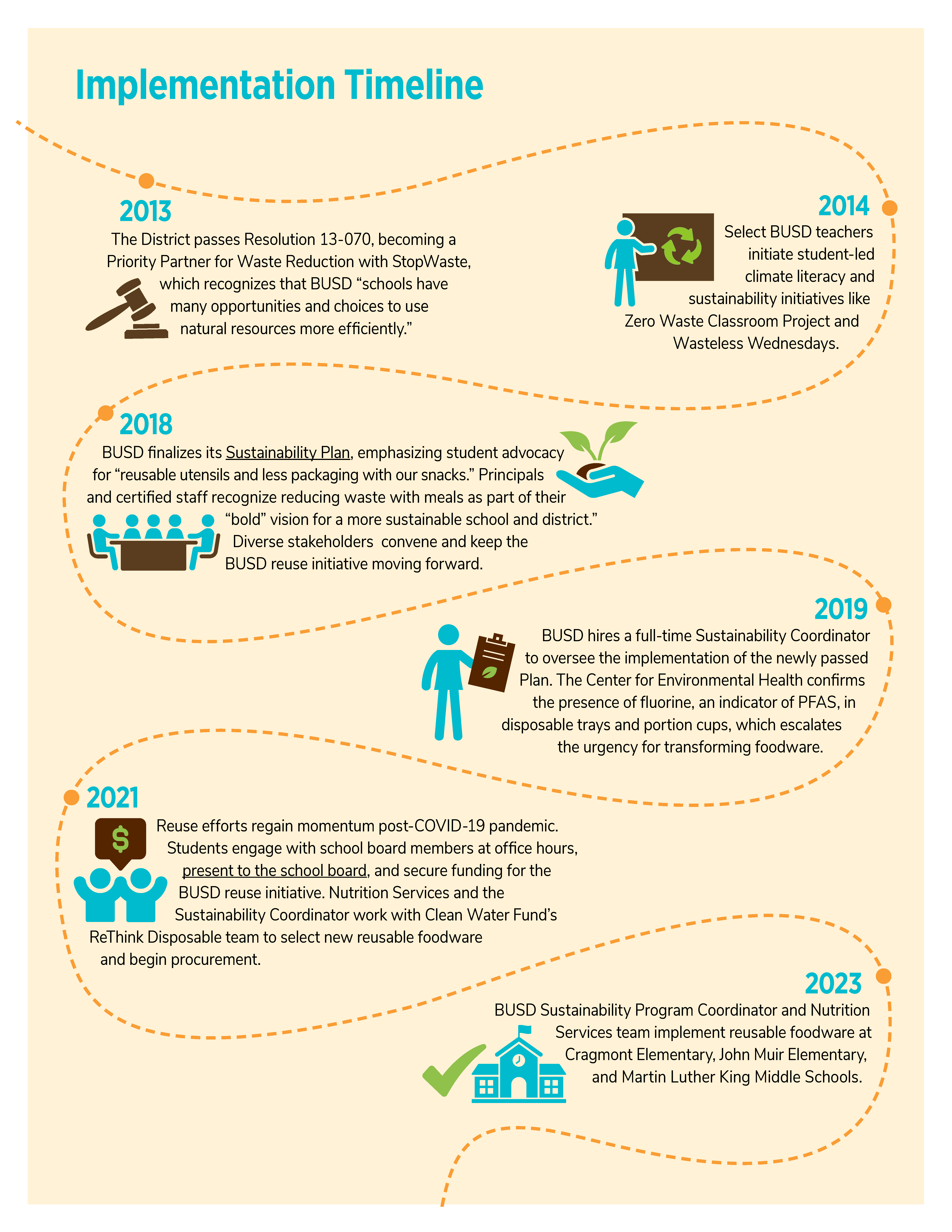
The journey to reusables for Berkeley Unified School District (BUSD) has been long and transformative. It began with discovery meetings in 2018 and was propelled forward by a dedicated team of students, teachers, administrators, parents, and local organizations. Heightened awareness over excessive single-use packaging during COVID, urgency to achieve zero emissions by 2050 through reductions in greenhouse gas emissions tied to disposable food packaging, and the impact of recent State and local policies mandating recycling were all critical factors that galvanized the decision to untether from disposable foodware. But the most pivotal driving force was the collective recognition that transitioning to reusable serviceware not only stops trash but empowers students with everyday sustainable habits for healthier lives.
By transitioning from single-use disposable food packaging to less-toxic durable alternatives at just 3 out of 16 schools, BUSD expects to eliminate 46,000 single-use utensils and 73,000 single-use trays in a given school year.
Business Profile:
Berkeley Unified School District (BUSD) is located in Berkeley, California with a student population of 9,801 and serves food for breakfast (classroom and cafeteria), lunch, and Child And Adult Care Food Program. BUSD is comprised of 11 elementary schools, 3 middle schools, one high school, and one alternative school. The average daily participation in school meals at the elementary and middle schools is 6,000 students for breakfast and 2,500 students for lunch. All food is prepared and distributed from the central scratch kitchen located at King Middle School.
In 2024, BUSD successfully implemented the first phase of reuse deployment at three schools: Cragmont Elementary School, John Muir Elementary School, and Martin Luther King Middle School. These schools were selected as the first cohort due to their existing dishwasher infrastructure, on-site staff capacity, and earlier return to the cafeteria.
The total cost for reusable stainless steel trays, sporks, cups, and bowls for 10 schools amounted to $52,970 that was funded primarily by the non-profit organization Plastic Free Restaurants. Rather than hiring additional staff, BUSD expanded the Nutrition Services Assistant job description by one hour, effectively creating a full-time position.
With a 180-day school year, the three participating schools collectively serve approximately 2,000 meals, daily. By transitioning from single-use disposable food packaging to less-toxic durable alternatives at just 3 out of 16 schools, BUSD expects to eliminate 46,000 single-use utensils and 73,000 single-use trays in a given school year. This change also includes replacing disposable cups and bowls with reusable alternatives, resulting in a total reduction of 170,000 single-use items per school year. This transformation diverts over 6,600 lbs of waste annually, equivalent to 4.3 pounds of trash per student. After the initial deployment of reuse, BUSD, annually saves more than $13,000 by cutting back on the purchase of disposable foodware. These annual savings are now available for other essential budgetary needs.
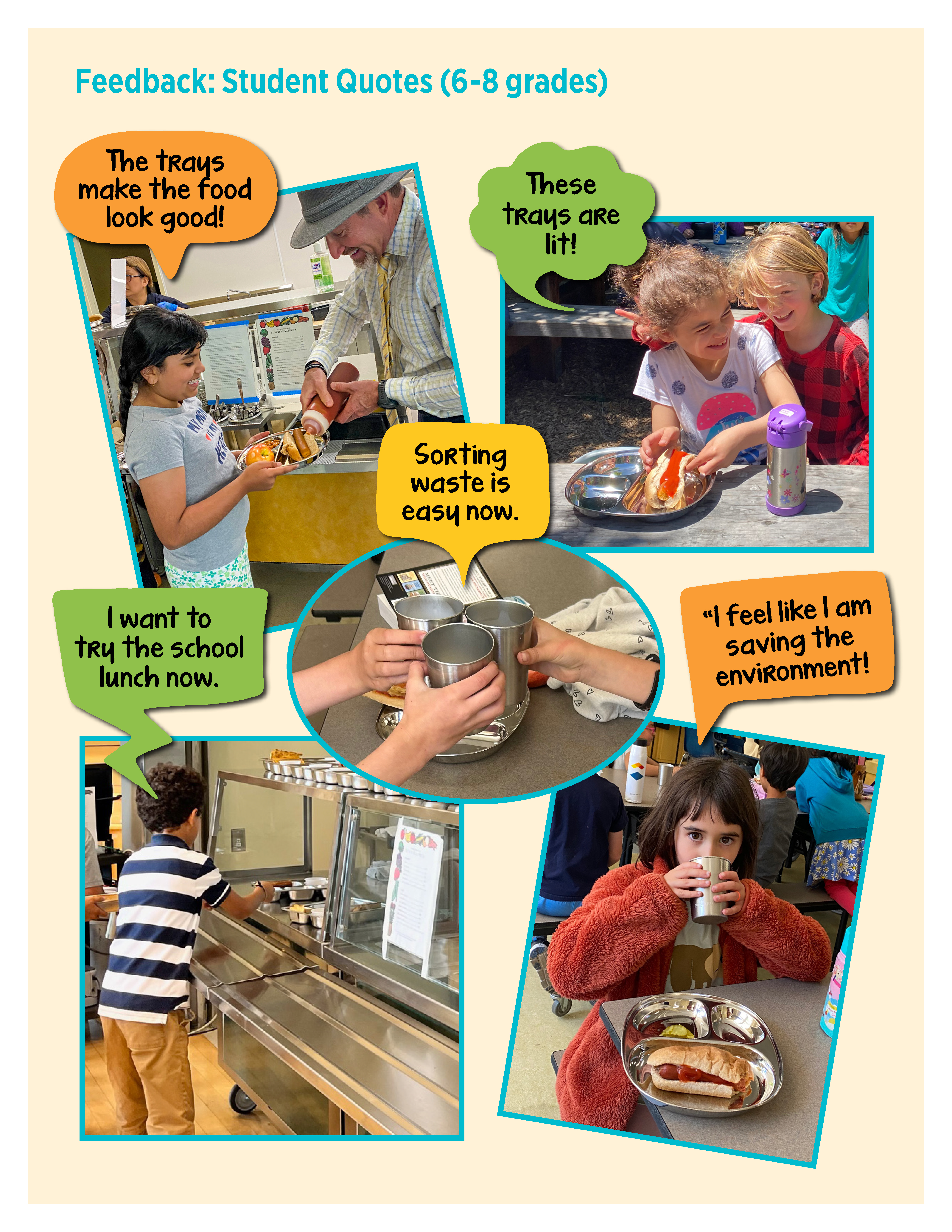
The students love the reusables, especially the older ones. It gives them a sense of eating on a plate like at home. My team thinks it’s increased the number of students eating school lunches and makes the food look more appealing.
Bonita Everfield, Cragmont Cafeteria Supervisor
Recommendations Implemented:
In 2024, BUSD successfully implemented the first phase of reuse deployment at three schools: Cragmont Elementary School, John Muir Elementary School, and Martin Luther King Middle School. These schools were selected as the first cohort due to their existing dishwasher infrastructure, on-site staff capacity, and earlier return to the cafeteria.
The total cost for reusable stainless steel trays, sporks, cups, and bowls for 10 schools amounted to $52,970 that was funded primarily by the non-profit organization Plastic Free Restaurants. Rather than hiring additional staff, BUSD expanded the Nutrition Services Assistant job description by one hour, effectively creating a full-time position.
New Reusable Foodware
- Stainless steel sporks — eliminated the need for separate spoons and forks
$1.16 each, includes shipping - Greensteel 10-ounce stainless steel cups
$2.50 each, includes shipping - Ahimsa 3-compartment stainless steel trays
$8.50 per unit - 10-ounce and 16-ounce double-walled stainless steel bowls
$5.96 each, includes shipping
Challenges
Keeping high return rates on reusables is an important challenge that needs to be overcome in a K-12 school reuse system. Having higher value reusables makes them feel more valuable to students (and adults) and this helps BUSD keep their loss rate very low. Still, utensils can often end up in the landfill or other waste bins. Here are a few simple ways to prevent utensils from being accidentally thrown away:
- Pair them with other larger reusables that match in material. The idea being, stainless steel trays do not end up in the trash, so stainless steel sporks should not either.
- Have clear signage and reuse return stations next to every refuse bin. Make sure that they are at eye level for the students.
- Start bussing stacks with a sample item and separate trays from the utensils and cups — this will help students see that “this is where the utensils go”, ”this is where the cups go”, “this is where the trays go”.
- Have green teams or bin monitors direct students on what goes where, particularly after the launch and at the beginning of the school year.
- Have open bins so if a student does throw away utensils, they can reach in and correct the mistake.
- Make sure the students can’t bend or break the utensils
To Be Continued...
The first wave of reuse deployment at BUSD highlighted the overarching waste issues at their schools. This work uncovered practical ways to green the District, resulting in significant waste reduction and annual net savings. BUSD plans to conduct a longitudinal waste assessment, which may reveal further opportunities to reduce costs by scaling back refuse hauling services.
Now, more than ever, the District is focused on continuing reuse efforts at additional schools with plans to have all schools transitioned by the Fall of 2026. The second phase will include the Berkeley Technology Academy, Malcolm X Elementary School, Oxford Elementary School, Ruth Acty Elementary School, Thousand Oaks Elementary School, and Willard Middle School. Projected metrics for second phase reuse deployment at a total of 9 schools show even greater benefits with annual reductions of 547,500 pieces of single-use foodware, weighing over 19,965 pound, resulting in annual net savings of nearly $40,000.
Additionally, BUSD aims to eliminate plastic packaging in its universal breakfast program. The Nutrition Service Department is reviewing contracts with local vendors who can provide the District with bulk cereal and is collaborating with the Sustainability Program to identify stainless steel packaging options.
Keep in Touch
Clean Water Fund and the Center for Environmental Health look forward to expanding BUSD’s reuse and waste reduction efforts, as outlined in the initial version of their case study. Please keep in touch to learn about additional initiatives and updated waste reduction data.
The reusables make my job a lot easier. The compost bin isn’t half as full as it used to be because there are no paper trays so I don’t have to switch the bag out as much. There’s still food waste that I wish didn’t exist but it’s all a work in progress.
Jackie Ray Jr, Cragmont Lead Custodian

Business Information:
2020 Bonar Street
Berkeley, CA 94702
United States
Document
CS_BUSD_09.20.24b.pdf
(4.05 MB)
The Bottom Line
Highlights
- Successfully piloted reusable foodware at two elementary schools and one middle school serving a total of 1,545 students
- Replaced 9 single-use foodware items with 4 reusable items
- Phase 1 resulted in $13,064 annual savings; Phase 2 will achieve $39,144 annual savings
- Phase 1 reduced waste by 3.3 tons (6,685 pounds), every school year; Phase 2 will reduce waste by 10 tons (19,965 pounds), every school year
- Annually eliminated 170,000 individual single-use items in Phase 1; 547,500 annually in Phase 2
- Upgraded a part-time Nutrition Services Assistant to full time by adding one additional hour per day to manage new wares
- Potentially reduces students’ exposure to chronic sources of PFAS
170,000 pieces
Disposable Items Eliminated Annually
6,685 lbs
Annual waste reduction
$13,064
Annual Net Cost Savings
The students love the reusables, especially the older ones. It gives them a sense of eating on a plate like at home. My team thinks it’s increased the number of students eating school lunches and makes the food look more appealing.

Reducing Single-Use Food Packaging
ReThink Disposable works with local governments, businesses and institutions, and consumers of single use food packaging to inspire a cultural shift away from single-use "throwaway" lifestyle.
Koreana Rittenhouse Square, Philadelphia
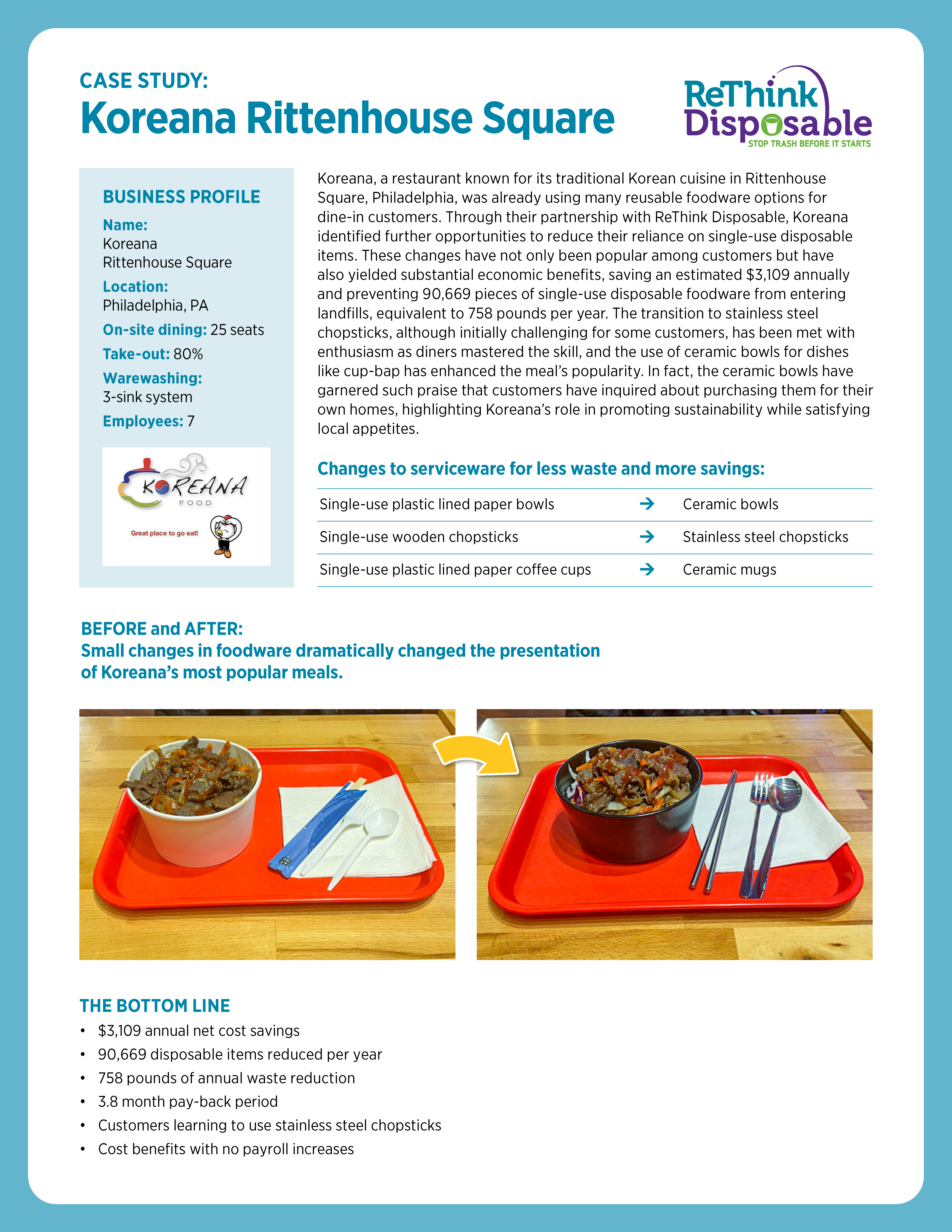
Koreana, a restaurant known for its traditional Korean cuisine in Rittenhouse Square, Philadelphia, was already using many reusable foodware options for dine-in customers. Through their partnership with ReThink Disposable, Koreana identified further opportunities to reduce their reliance on single-use disposable items. These changes have not only been popular among customers but have also yielded substantial economic benefits, saving an estimated $3,109 annually and preventing 90,669 pieces of single-use disposable foodware from entering landfills, equivalent to 758 pounds per year.
The transition to stainless steel chopsticks, although initially challenging for some customers, has been met with enthusiasm as diners mastered the skill, and the use of ceramic bowls for dishes like cup-bap has enhanced the meal’s popularity. In fact, the ceramic bowls have garnered such praise that customers have inquired about purchasing them for their own homes, highlighting Koreana’s role in promoting sustainability while satisfying local appetites.
Packaging practices prior to ReThink Disposable:
- Single-use plastic lined paper bowls
- Single-use wooden chopsticks
- Single-use plastic lined paper coffee cups
Recommendations Implemented:
- Ceramic bowls
- Stainless steel chopsticks
- Ceramic mugs
Before & After


Business Information:
37 S 19th St
Philadelphia, PA 19103
United States
Document
The Bottom Line
Small changes in foodware dramatically changed the presentation of Koreana’s most popular meals. Customers are learning to use stainless steel chopsticks and after a 3.8 month pay-back period cost benefits are being seen with no payroll increases.
$3,109
annual net cost savings
90,669
disposable items reduced per year
758 lbs
annual waste reduction
Reducing Single-Use Food Packaging
ReThink Disposable works with local governments, businesses and institutions, and consumers of single use food packaging to inspire a cultural shift away from single-use "throwaway" lifestyle.
Jean's Cafe, Philadelphia
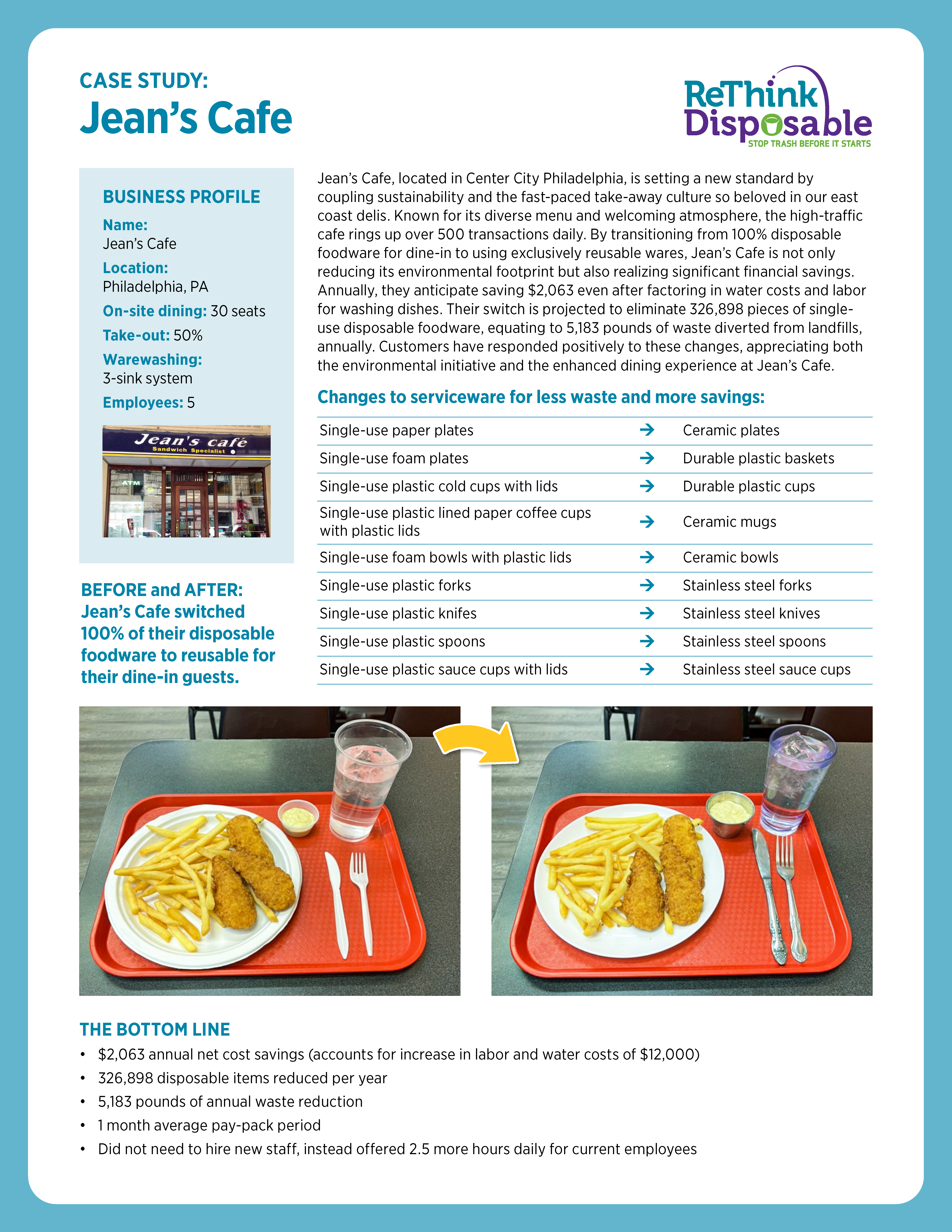
Jean’s Cafe, located in Center City Philadelphia, is setting a new standard by coupling sustainability and the fast-paced take-away culture so beloved in our east coast delis. Known for its diverse menu and welcoming atmosphere, the high-traffic cafe rings up over 500 transactions daily. By transitioning from 100% disposable foodware for dine-in to using exclusively reusable wares, Jean’s Cafe is not only reducing its environmental footprint but also realizing significant financial savings. Annually, they anticipate saving $2,063 even after factoring in water costs and labor for washing dishes. Their switch is projected to eliminate 326,898 pieces of single use disposable foodware, equating to 5,183 pounds of waste diverted from landfills, annually. Customers have responded positively to these changes, appreciating both the environmental initiative and the enhanced dining experience at Jean’s Cafe.
Packaging practices prior to ReThink Disposable:
- Single-use paper plates
- Single-use foam plates
- Single-use plastic cold cups with lids
- Single-use plastic lined paper coffee cups with plastic lids
- Single-use foam bowls with plastic lids
- Single-use plastic forks
- Single-use plastic knifes
- Single-use plastic spoons
- Single-use plastic sauce cups with lids
Recommendations Implemented:
- Ceramic plates
- Durable plastic baskets
- Durable plastic cups
- Ceramic mugs
- Ceramic bowls
- Stainless steel forks
- Stainless steel knives
- Stainless steel spoons
- Stainless steel sauce cups
Before & After


Document
PA ReThinkDisposableCaseStudy_JeansCafe.1.pdf
(486.92 KB)

Business Information:
1334 Walnut St.
Philadelphia, PA 19107
United States
The Bottom Line
Jean’s Cafe switched 100% of their disposable foodware to reusable for their dine-in guests, with a 1 month average pay-back period. They did not need to hire new staff, instead offered 2.5 more hours daily for current employees. The annual cost savings accounts for increase in labor and water costs of $12,000.
$2,063
annual net cost savings
326,898
disposable items reduced per year
5,183 lbs
annual waste reduction
Reducing Single-Use Food Packaging
ReThink Disposable works with local governments, businesses and institutions, and consumers of single use food packaging to inspire a cultural shift away from single-use "throwaway" lifestyle.
Interfaith Neighbors Meals on Wheels Monmouth County | Video
As a result of working with ReThink Disposable, Interfaith Neighbors has eliminated distributing fruit cups, as well as individually wrapped desserts, and is now providing clients with fresh fruit. This practice also reduces the number of paper bags used for delivery. The changes are a healthier alternative for both the client and environment and saves essential funds that can be used to better serve their client.
Business Profile:
Founded in 1988, Interfaith Neighbors has been assisting the most vulnerable in Monmouth County, New Jersey in securing life’s critical necessities, while working to improve the quality of life for individuals, families, and their communities. Interfaith Neighbors provides multiple services, including daily meals through their Meals on Wheels programs.
Packaging practices prior to ReThink Disposable:
Prior to working with ReThink Disposable, the organization has been providing a fruit cup in small single-use containers and monthly spent thousands of dollars ordering products.
Recommendations Implemented:
Interfaith Neighbors replaced their daily 4-ounce fruit cocktail containers and plastic-wrapped individual desserts for fresh fruit. Staff are pleased with providing healthier food to their clients and clients have expressed their delight at getting fresh fruit.
There was a $0 upfront cost for these new zero-waste practices.
Before & After


Document
Business Information:
810 4th Avenue
Asbury Park, NJ 07712
United States
The Bottom Line
$72,000
Total annual cost savings
986,960
Disposable items reduced each year
8,702 lbs
Annual waste reduction
My eyes were made wide open. We replaced a plastic fruit cup, mainly sugar, with a fresh piece of fruit. We took sugary desserts out of our meals as well. Many are diabetic so this is a cost savings as well as a much more nutritious alternative.
Reducing Single-Use Food Packaging
ReThink Disposable works with local governments, businesses and institutions, and consumers of single use food packaging to inspire a cultural shift away from single-use "throwaway" lifestyle.
Interfaith Neighbors Senior Center Program
As a result of working with ReThink Disposable, Interfaith Neighbors is now serving their clients with more dignity, as they provide a hot meal at all six Senior Centers on reusable foodware. They have eliminated the distribution of plastic single-use disposable fruit cups and individually wrapped desserts. Currently, they provide clients with fresh fruit. This is a healthier alternative for both the client and environment. Through their partnership with ReThink Disposable, Interfaith Neighbors is saving valuable funds that can be used to better serve their clients.
Business Profile:
Founded in 1988, Interfaith Neighbors in Monmouth County, New Jersey has been securing life’s critical necessities for the most vulnerable while improving the quality of life for individuals, families, and their communities. Interfaith Neighbors provides multiple services, including daily dine-in meals through their six senior nutrition programs.
Packaging practices prior to ReThink Disposable:
Prior to working with ReThink Disposable, the organization had been serving clients on exclusively single-use disposable foodware. They also had been providing fruit cocktail in disposable individual portion cups. They were spending thousands of dollars each month, ordering these items that eventually went into the waste stream.
Recommendations Implemented:
Single-use plastic fruit cups with foil lids were replaced with fresh fruit. Bowls and plates were replaced with reusable alternatives, paper cups were replaced with glass mugs and reusable cups, and single-use plastic cutlery was replaced with steel cutlery. The initial investment on new foodware was $2,910, and Interfaith Neighbors eliminated 100% of their single-use disposable foodware.
Before & After


Document
Business Information:
810 4th Avenue
Asbury Park, NJ 07712
United States
The Bottom Line
$37,113
Total annual net cost savings
326,000
Disposable items reduced each year
5,155 lbs
Annual waste reduction
Reducing Single-Use Food Packaging
ReThink Disposable works with local governments, businesses and institutions, and consumers of single use food packaging to inspire a cultural shift away from single-use "throwaway" lifestyle.