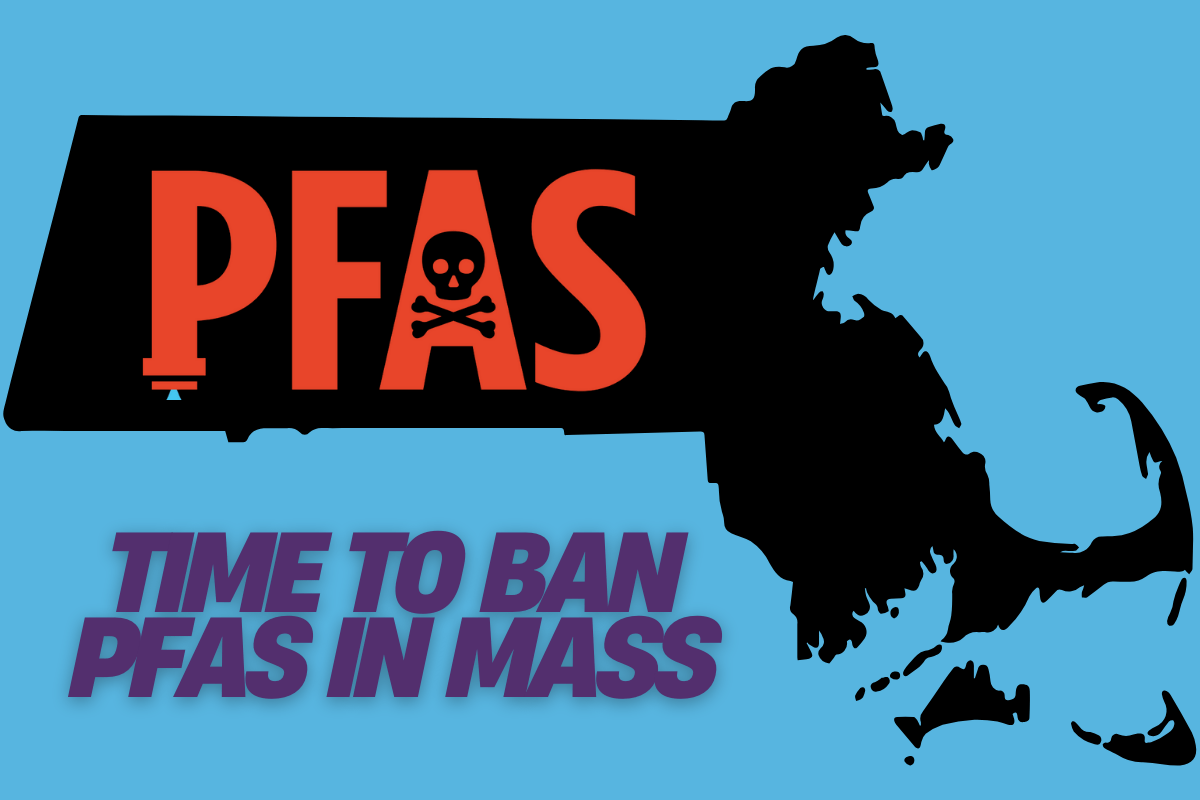
Boston, MA: A bill to protect public health from toxic “forever chemicals” known as PFAS passed a key hurdle in the state Legislature after winning passage in the House from the Joint Committee on Public Health.
An Act to Protect Massachusetts Public Health From PFAS (H4870/S1504) filed by state Rep. Kate Hogan (Stow) and Senator Julian Cyr (Provincetown) would phase out per- and polyfluoroalkyl substances (PFAS) in many products; cut industrial discharges of PFAS; and set up a fund to help communities test and treat PFAS in drinking water, soil, and groundwater. The House bill passed committee and the Senate bill is pending action.
“This is great news for Massachusetts residents,” said Deirdre Cummings, MASSPIRG Legislative Director. “We appreciate the leadership of Rep. Kate Hogan and Rep.Marjorie Decker, the House Chair of the Committee on Public Health in getting this important bill moving.”
In Massachusetts, 172 public water systems in 96 cities and towns, and many private wells, have exceeded the state’s legal limit (Maximum Contaminant Level) for PFAS. PFAS are a class of man-made chemicals that are used in many consumer products and industrial applications. They are toxic even at very low level exposure and do not break down easily, meaning they will persist for thousands of years in the environment. PFAS can increase the risk of developing cancers, immunosuppression, liver disease, and developmental and reproductive illnesses. Twenty eight states have passed laws to ban PFAS in at least one product.
Every New England state except Massachusetts has already banned PFAS in carpets/rugs, children’s products, clothing, food packaging, firefighting foam, fabric sprays, and personal care products. All but New Hampshie have restricted PFAS in cookware, and all but Rhode Island have banned PFAS in upholstered furniture and furniture textiles.
“Other states have already enacted laws to restrict PFAS in some or all products,” said Laura Spark, Environmental Health Program Director at Clean Water Action. “Now it’s time for Massachusetts to act. PFAS contamination in Massachusetts will continue to worsen until PFAS restrictions go into effect.”
The House and Senate bills are cosponsored by a bipartisan majority of lawmakers and supported by a broad coalition of public health, consumer, municipal, environmental and community organizations along with academics, scientists and firefighters. The bill is pending committee action in the Senate.
Download our Fact Sheet on the Bill Here
Since the organization’s founding during the campaign to pass the landmark Clean Water Act in 1972, Clean Water Action has worked to win strong health and environmental protections by bringing issue expertise, solution-oriented thinking, and people power to the table. Learn more at cleanwater.org