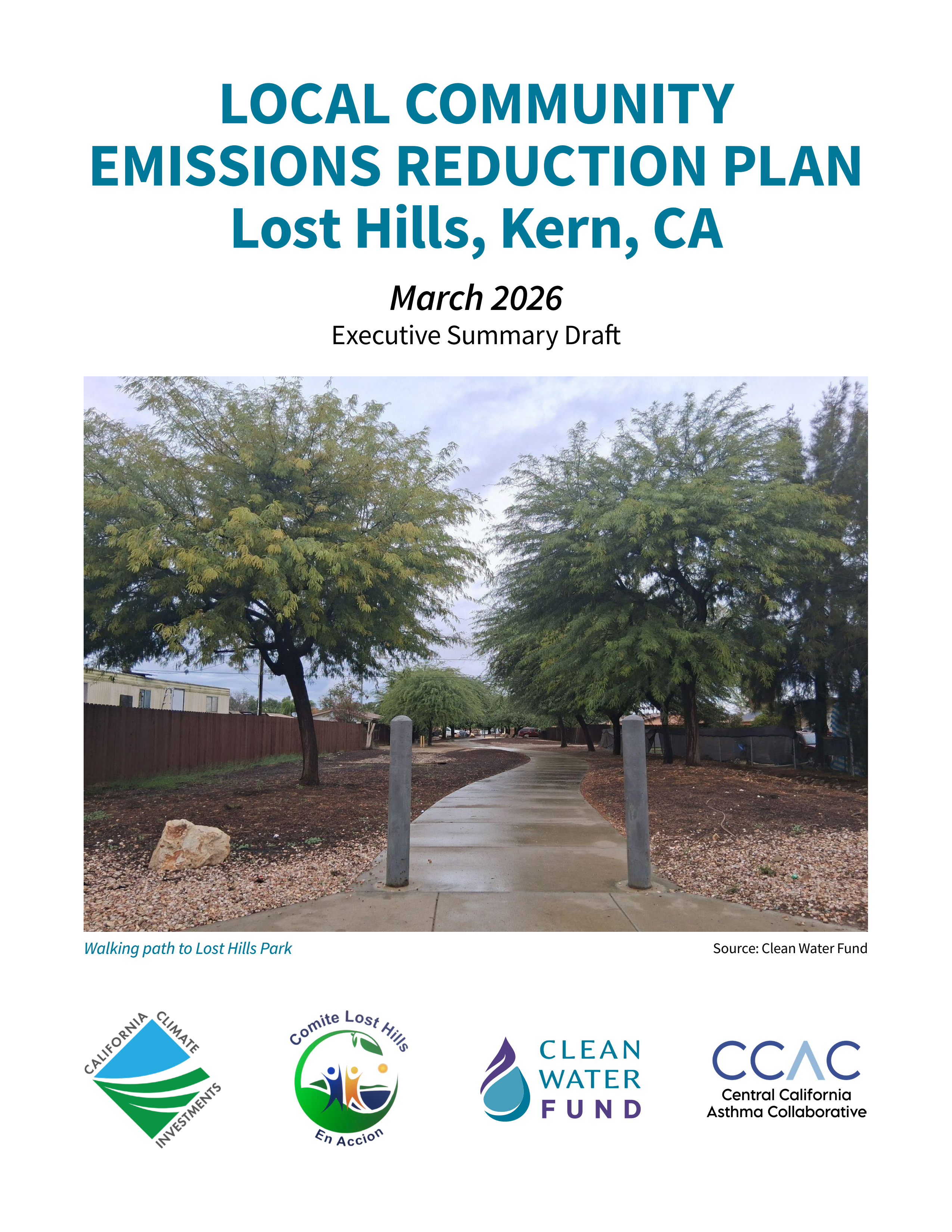
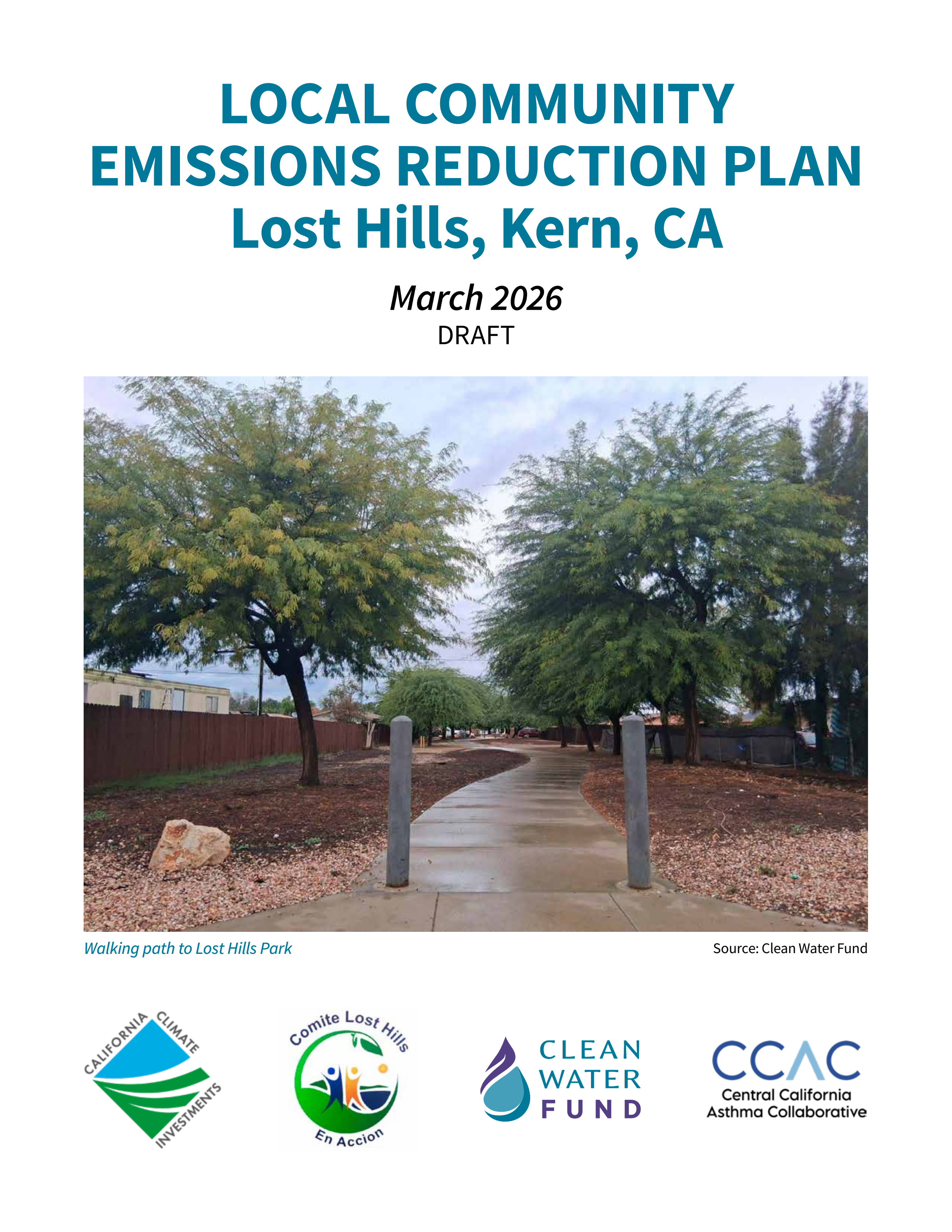
View the Executive Summary View the Full Document
1. Executive Summary
Over a period of 18 months, the Lost Hills Community Steering Committee (LCSC) held approximately 30 meetings to develop this Local Community Emissions Reduction Plan (LCERP). The LCSC has worked in collaboration with the CARB, the Valley Air District (VAD), residents, local businesses, and local government. The Plan includes technical information provided by CARB and input from communities on local impacts and selection of strategies for reducing local emissions that are best suited to Lost Hills.
- Chapter 1 of the plan provides an overview of the AB 617 program and process.
- Chapter 2 provides information about formation and operation of the LCSC and how it communicated with fellow residents.
- Chapter 3 provides an in-depth community profile, description of current and past monitoring efforts and summarizes the technical assessment developed by CARB.
- Chapter 4 provides a suite of emission reduction strategies identified by the LCSC as suitable for Lost Hills.
- Chapter 5 provides an overview of next steps for plan implementation.
- Additional information, including the LCSC community charter, the SNAPS air monitoring report and the CARB Technical Assessment are provided as appendices.
ES.1 Overview of AB 617 and LCERP
The California Air Resources Board (CARB) administers AB (Assembly Bill) 617 through its Community Air Protection Program (CAPP) and is tasked with ensuring the benefits of AB 617 are made available to all eligible communities in the state, especially those who live in the areas of California most severely impacted by air pollution. To meet its obligation, CARB created the Community Air Grants Program (Air Grants Program), which has a goal of providing support for community-based organizations to participate in the AB 617 process, and to build capacity to become active partners with the government to identify, evaluate, and reduce air pollution and exposure to harmful emissions in their communities. In 2024, a Community Air Grant was awarded to Clean Water Fund (CWF) to work with the community of Lost Hills to develop a Local Community Emissions Reduction Plan (LCERP).
Lost Hills is a small, predominantly Hispanic community in western Kern County. Over 97% of its approximately 2,370 residents identify as Hispanic or Latino. The community faces disproportionately high levels of exposure to toxic air pollution from multiple pollution sources. Data collected between 2015–2019 shows consistently harmful levels of ozone and fine particulate matter (PM2.5). Data collection did not include source detection. With an economy heavily reliant on oil, gas and agriculture, Lost Hills experiences both economic dependence on polluting industries and environmental harm. The Community Air Grants Program provides a critical opportunity to empower communities to engage in solutions that protect public health and advance environmental justice.
Plan development included daily monitoring of community air quality through the Central California Asthma Collaborative’s (CCAC) SJVAir.com, a monitoring and mapping tool developed by CCAC. Notifications and alerts from VAD were also used to track air events. In addition, the Central California Environmental Justice Network (CCEJN) was contracted to conduct tours using a FLIR camera to detect emissions, and train community members on the use of Summa Canisters to collect, store and transport air samples for laboratory analysis. LCSC members were trained to report incidents through the KEEN IVAN Network (kernreport.org) and through the VAD.
This plan is focused on reducing individual criteria air pollutant and toxic air contaminant emissions to address the impacts of community exposure to multiple pollutants. While every community faces distinct health- based challenges, CARB guidance states that broad health-based air quality objectives provide a consistent foundation for determining the appropriate levels of emissions reductions for CERPs and LCERPS statewide. This LCERP includes a technical analysis prepared by CARB (Appendix B) describing the sources of pollution affecting the community, the location of sensitive receptors within the community and an assessment of the most prevalent and concerning contaminants affecting the community. These are the pollutants targeted by the LCSC in its development of the plan.
ES.2 Community Partnerships and Engagement
The Lost Hills Local Community Steering Committee (LCSC) is an advisory body guiding the development of the Local Community Emission Reduction Plan (L-CERP). The Committee works in partnership with the Central California Asthma Collaborative (CCAC), the Central California Environmental Justice Network (CCEJN), the California Air Resources Board (CARB), Clean Water Fund (CWF), and community leaders to ensure that community priorities are integrated into local and state air quality planning efforts.
The LCSC and its supporting members have been an integral part of sustaining the committee and engaging the public to be an inclusive part of the planning process. LCSC members and CWF have conducted door-to- door outreach and approached community members at church, school and community events. They have met with board members of the Lost Hills Utilities District (LHUD), Lost Hills Unified School District (LHUSD) and Lost Hills Community Advisory Board (CAB) to extend an invitation to participate and answer questions about the process and goals of the LCERP. A standing call list of about 25 community members is contacted prior to each meeting. Prior to each LCERP meeting the agenda has been posted on the Comité Lost Hills En Acción (CLHEA) Facebook page and in key community locations. In addition, a website was established (www.comitelosthills.org) to post agendas, meeting minutes and documents. Outreach efforts prioritized engaging residents from historically underrepresented groups, including farmworkers, Spanish-speaking households, and families living near major pollution sources and holding meetings at accessible times and locations.
The Community Kickoff in August 2024 was attended by 10 community members as well as staff from CARB and VAD. The kickoff provided space for regulatory bodies to showcase their role and defined the roles of the community organizations and facilitators. Community members were able to identify some of their interests in developing the Plan and provided feedback to CARB and VAD about some of the challenges of reporting issues, particularly for monolingual Spanish speakers. Those attending comprised the eventual Steering Committee membership.
From its initial meeting, the Local Community Steering Committee (LCSC) began learning about the purpose and process of this project and discussing emission concerns in their community. The LCSC identified several stationary and mobile pollution sources:
Mobile Sources: State Route 46 runs through the center of the community and has recently been expanded into a 4-lane highway. Interstate 5 brings significant traffic to the community.
Stationary Sources: The Lost Hills Oil Field, one of the largest in the state, lies directly west of Lost Hills and is owned by California Resources Corporation, Aera and Chevron. There were also concerns about agricultural work in the area, including pesticide application, agricultural burning and the Wonderful Company nut processing plant.
Residents also wished to measure and identify the source of high Acrolein levels identified in the 2024 SNAPS report.
In discussing solutions, the LCSC expressed a need for more or better incentives and enforcement in residential wood and waste burning, replacement of high emitting items in the home and more environmental greening, as well as vegetative protections for schools and homes. Community members also expressed a desire for more localized emissions reduction and incentivization through electrification of vehicles, school buses, charging stations and other emission producing products.
The LCSC’s first action was to develop a charter to guide governance decisions and the operation of the Committee. That charter can be found in Appendix A. As part of charter development, the LCSC identified its objectives for the LCERP. The first objective of the LCSC is to identify and prioritize air pollution sources that most significantly impact the health and well-being of Lost Hills residents and the surrounding region. This includes evaluating pollution sources within community boundaries as well as those located at reasonable distances outside the community that contribute to cumulative exposure. The second objective of the LCSC is to explore and recommend feasible emission reduction strategies and air quality improvement measures that reflect both technical data and lived community experience.
ES.3 Understanding the Community
Concurrent with the development of the community charter, the LCSC began to discuss the plan’s boundaries. In addition to the community of Lost Hills, LCSC members were adamant that communities outside the strict community boundaries be included, including the trailer park north of Lost Hills, Blackwell Corner to the west, and the small community along Lerdo Highway to the South. The LCSC also wanted to ensure that major pollution sources were included within the boundaries to the extent possible.
Lost Hills Community Profile. The Lost Hills community is located in Western Kern County. Its 2 largest industries are corporate agriculture and large-scale oil and gas operations. The community includes one public park and 2 schools. Cal EnviroScreen 4.0 ranks the community as one of the most overburdened by pollution and other data indicates severe socioeconomic vulnerability. Overall, the data shows that Lost Hills is one of California’s most environmentally and socioeconomically burdened communities, highlighting significant environmental justice concerns. The community is surrounded by heavy industry, bisected by a major state route and bounded to the east by Interstate 5. Other pollution sources bordering the community include a hazardous waste facility, gas plant and a nut processing facility.
CARB has developed a technical assessment of the community, identifying sensitive receptors in the community and providing a loading estimate of the major pollutants impacting the community and also identifying sources for those emissions. That technical report can be found in Appendix B of this report.
Monitoring. Lost Hills has been part of several short-term monitoring efforts over the past 12 years beginning with a 2015 study published by CWF and Earthworks. The first Community Air Grant awarded to Lost Hills created a community monitoring plan that included continuous reporting to a website maintained by the technical consultant, Blue Tomorrow. In 2018, Lost Hills was chosen as the first community in California to host a SNAPS survey, a high-level mobile and stationary air monitoring project conducted by CARB. The SNAPS report on its Lost Hills monitoring was completed in October 2025 and included a second round of monitoring in early 2025 to investigate a troubling finding of elevated levels of acrolein, a biocide that can be used in both the agricultural and oil and gas industries. That report can be found in Appendix B. Investigations of acrolein in the community were continued by Aclima Inc. in 2025. Aclima was contracted by CARB to conduct is Statewide Mobile Monitoring Initiative (SMMI).
With the publication of the SNAPS study, the Aclima mobile monitoring study, and monitoring equipment installed by CCAC and CCEJN, the community of Lost Hills is finally able to receive consistent ongoing results about the community’s air quality. The community is particularly interested in the source of high acrolein levels detected during the initial SNAPS monitoring effort, as well as the frequency, duration and source of VOC spikes that have been detected during prior monitoring efforts.
ES.4 Community Strategies
The Lost Hills LCSC members participated in a facilitated exercise to identify and prioritize their air pollution sources of concern. Participants were asked to share their thoughts regarding air pollution sources which they believed impacted their community the most, or was of most concern to the individual or entity they represented.
To address multiple and cumulative pollution sources, the LCERP has prioritized community-driven strategies that reduce exposure at the source while providing immediate health protections. Examples of proposed solutions include installing vegetative barriers to reduce pesticide drift and roadway emissions, strengthening pesticide safety practices, and developing alternative truck routes to divert heavy-duty vehicles away from residential areas. Investments in electric vehicle infrastructure aim to reduce transportation-related emissions, while air filtration programs and wood stove replacement initiatives will help lower indoor air pollution. Dust mitigation measures will target emissions from agricultural operations, roadways, and open land to reduce particulate matter exposure.
Stationary sources of pollution remain a critical focus of the plan. Major facilities such as The Wonderful Company, Chevron, Aera Energy, and California Resources Corporation (CRC) contribute to localized emissions and require targeted monitoring and mitigation. The LCERP emphasizes accountability and collaboration with these operators to reduce emissions that impact surrounding communities.
Policy recommendations supporting the plan include enforceable dust reduction measures, land-use and emissions standards for warehouses, and stronger regulation of methane emissions. The use of advanced technologies, such as camera-based methane detection systems, is recommended to improve transparency, monitoring, and rapid response to leaks from oil and gas infrastructure.
Implementation of the LCERP will be supported through available funding and technical resources, including the Carl Moyer Program, Agricultural Innovation Zones, and incentives for sustainable agricultural practices. Additional opportunities exist through Greenhouse Gas Reduction Fund (GGRF) investments to advance clean transportation, clean energy, and emissions reduction projects. Together, these strategies form a comprehensive approach to reducing emissions, improving air quality, and advancing environmental justice for the community.
ES.5 Next Steps
Now that the LCSC has identified its priorities for reducing local emissions, implementation of the plan will proceed. Identified next steps are to:
- identify strategies that can be implemented as part of the CAG 5 grant for Lost Hills;
- work with state and local agencies to identify resources to implement the plan;
- identify needed resources and/or policy changes that can advance strategies that currently lack
resources or data; - overcome barriers to accessing resources;
- continue monitoring to build a record of air quality data and trends; and
- identify strategies in response to Aclima monitoring results, which may provide greater information on pollution sources within the community, particularly the source of elevated acrolein levels.
The award of a CAG 5 allows some recommendations to be implemented immediately. For example, CWF is partnering with Cal State Fresno to design and execute a community health assessment in Lost Hills in the spring of 2026. The grant also provides funding to empower community members to travel to visit decision-makers and make their case for resources or policy changes.
Finally, the development of metrics will occur with the implementation of individual strategies.