Filter By:
Type
State
Priority
Posted On
Search Results
House of Bread, Hartford, CT
The House of Bread Soup Kitchen is in the center of Connecticut’s Capitol City and serves over 250 daily meals to food-insecure residents. They were using primarily donated disposable cups, bowls, and utensils. ReThink Disposable helped the House of Bread make the transition to 100% reusable service ware for all meals.
Switching to reusables will save the organization over $1,600 annually and keep over 120,000 disposable items out of the trash each year. This translates to 845 pounds of annual waste reduction. The two inspirational nuns who volunteer for the program, Sr. Maureen and Sr. Theresa, report that switching to reusables also gives the food-insecure residents who dine at the House of Bread a more elevated dining experience, contributing to a community feeling when dining together.
Read The Full Case Study Here (PDF)
ReThink Disposable is a program of Clean Water Action and Clean Water Fund conducted in partnership with local organizations, businesses, and government agencies. Generous support is provided by a changing list of public and private funders. To learn more about the program, its partners, and funders, visit: www.rethinkdisposable.org.
Packaging practices prior to ReThink Disposable:
- Single-use plastic cold cup
- Single-use expanded polystyrene hot cup
- Single-use plastic spoon
- Single-use plastic fork
- Single-use plastic knife
- Single-use paper soup container with lid
Recommendations Implemented:
- 5oz durable plastic cup
- 8oz ceramic mug
- Stainless steel spoon
- Stainless steel fork
- Stainless steel butter knife
- 8oz ceramic bowl

Document
ReThink-CT-Case-Study-House-of-Bread.pdf
(1.19 MB)
Business Information:
27 Chestnut St
Hartford, CT 06120
United States
The Bottom Line
$1,643.70
net annual savings
123,500
disposable items reduced per year
845 pounds
annual waste reduction
The House of Bread is always looking for ways to improve how we can best help our clients AND how we can help Mother Nature! Our next step toward improving our environmental impact was to eliminate the plastic utensils, bowls, and cups that we use and replace them with reusable, washable items. As a New England Zero Waste Organizer, Amber was instrumental in making this happen and was simply a joy to work with.

Reducing Single-Use Food Packaging
ReThink Disposable works with local governments, businesses and institutions, and consumers of single use food packaging to inspire a cultural shift away from single-use "throwaway" lifestyle.
Truro Community Kitchen, Truro, MA
Truro Community Kitchen (TCK) is a non-profit food provider on Cape Cod in Truro, Massachusetts founded in April of 2020 to combat food insecurity during the COVID-19 pandemic. Their mission has continued, and every Tuesday, a team of volunteers carries out the preparation, packaging, and delivery of free and anonymous meals to registered households.
Working with ReThink Disposable, TCK has replaced 100% of their disposable plastic items with reusable containers that are returned, washed, and sanitized for reuse. Truro Central School generously donates the use of their dishwasher each Tuesday to TCK’s Green Team, who sanitize and store the containers for recirculation. This reuse system will save TCK $6,700 in annual costs and prevent 12,000 plastic items from entering the trash each year. The return program uses an honor system, rather than QR codes or phone apps, so both TCK and program participants incur zero costs.
Read The Full Case Study Here (PDF)
ReThink Disposable is a program of Clean Water Action and Clean Water Fund conducted in partnership with local organizations, businesses, and government agencies. Generous support is provided by a changing list of public and private funders. To learn more about the program, its partners, and funders, visit: www.rethinkdisposable.org.
Packaging practices prior to ReThink Disposable:
- Single-use black plastic 3-compartment container
- Single-use black plastic 3-compartment container
- Single-use clear plastic single container
- Brown paper bag
Recommendations Implemented:
- Reusable plastic 9"x9" 3-compartment container
- Reusable plastic 9"x6" single compartment container
- Reusable plastic 5"x5"x3" container
- Reusable branded cloth bag*
*After several months, TCK opted to revert to sending meals to recipients in brown paper bags. They continue to use the reusable bags as container collection bags that are distributed with the meals. The reason for making this change was the difficulty washing and drying the bags each week. A better washable material bag would be recommended for entirely eliminating paper bags.

Document
Business Information:
P.O. Box 1053
North Truro, MA 02652
United States
The Bottom Line
$6,700
net annual savings
18,000
disposable items reduced per year
1.2 tons
annual waste reduction
Four years and 26,000 meals after we started, it is more than time for us to transition away from serving our meals in disposable takeout materials. This sustainability initiative is so exciting not only because it will help us hugely reduce the amount of waste we produce, but also because it is proof that TCK is prepared to stick around and support our community for the foreseeable future.
Reducing Single-Use Food Packaging
ReThink Disposable works with local governments, businesses and institutions, and consumers of single use food packaging to inspire a cultural shift away from single-use "throwaway" lifestyle.
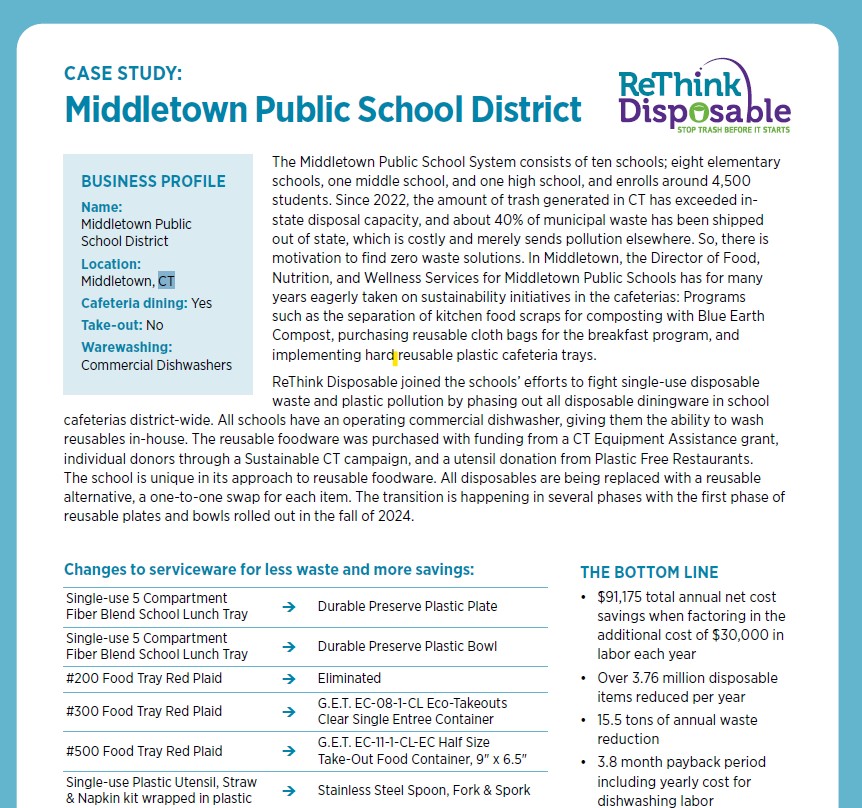
Middletown, CT Public School District
Since 2022, the amount of trash generated in Connecticut has exceeded instate disposal capacity, and about 40% of municipal waste has been shipped out of state, which is costly, so there is motivation for waste reduction statewide. The Middletown Public School System consists of ten schools (eight elementary schools, one middle school, and one high school) and enrolls around 4,500 students. For many years, the Director of Food, Nutrition, and Wellness Services has eagerly taken on sustainability initiatives in the cafeterias such as the separating kitchen food scraps for composting with Blue Earth Compost, purchasing reusable cloth bags for the breakfast program, and implementing hard reusable plastic cafeteria trays.
ReThink Disposable has joined the schools’ efforts to fight single-use disposable waste and plastic pollution by phasing out all disposable dining ware in school cafeterias district-wide. All disposables are being replaced with a reusable alternative, a one-to-one swap for each item. The transition is happening in several phases with the first phase of reusable plates and bowls rolled out in the fall of 2024.
All schools have an operating commercial dishwasher, giving them the ability to wash reusables in-house. The reusable food ware was purchased with funding from a CT Equipment Assistance grant, individual donors through a Sustainable CT campaign, and a utensil donation from Plastic Free Restaurants.
Read The Full Case Study Here (PDF)
ReThink Disposable is a program of Clean Water Action and Clean Water Fund conducted in partnership with local organizations, businesses, and government agencies. Generous support is provided by a changing list of public and private funders. To learn more about the program, its partners, and funders, visit: www.rethinkdisposable.org.
Packaging practices prior to ReThink Disposable:
- Single-use 5 Compartment Fiber Blend School Lunch Tray
- Single-use 5 Compartment Fiber Blend School Lunch Tray
- #200 Food Tray Red Plaid
- #300 Food Tray Red Plaid
- #500 Food Tray Red Plaid
- Take-Out Food Container, 9" x 6.5"
- Single-use Plastic Utensil, Straw & Napkin kit wrapped in plastic
- Single-use plastic 5.5 oz Portion Container
- Single-use plastic 5.5 oz Portion Container
- Clear Portion 5 oz/5.5 oz lid
- Ziplock Sandwich Bag
Recommendations Implemented:
- Durable Preserve Plastic Plate
- Durable Preserve Plastic Bowl
- #200 Food Tray Red Plaid - Eliminated
- G.E.T. EC-08-1-CL Eco-Takeouts Clear Single Entree Container
- G.E.T. EC-11-1-CL-EC Half Size Take-Out Food Container, 9" x 6.5"
- Stainless Steel Spoon, Fork & Spork
- G.E.T. EC-20-CL Sauce Cup 6.75 oz
- G.E.T. Eco-Takeouts 3 oz Jade Green Customizable Sauce Container
- Clear Portion 5 oz/5.5 oz lid - Eliminated
- Ziplock Sandwich Bag - Eliminated

Document
Business Information:
Middletown, CT 06457
United States
The Bottom Line
$91,175
net annual savings
3.76 million
disposable items reduced per year
15.5 tons
annual waste reduction
Here in Middletown Public Schools, one of our goals in switching to reusable utensils and servingware is to utilize the funds that would have gone to disposable items and instead reinvest them into the quality of our food. It was estimated that in this switch we will be saving around $100,000 per school year; with this savings we will focus on buying locally grown foods from small farmers and growers throughout the state of Connecticut with a specific focus in supporting farmers and growers of color. These funds will greatly improve our quality of food and bring more variety to our students during mealtimes.
Reducing Single-Use Food Packaging
ReThink Disposable works with local governments, businesses and institutions, and consumers of single use food packaging to inspire a cultural shift away from single-use "throwaway" lifestyle.
Marisa Perales
Austin, TX Marisa Perales is a partner in a small environmental law firm that advocates against polluters and in favor of the public's interest throughout Texas. The firm addresses all sorts of environmental issues that arise in Texas, including municipal, hazardous, and radioactive waste storage and disposal; water quality and air pollution; endangered species protection; and incompatible land uses. Ms. Perales also serves as board president of Texas Campaign for the Environment Fund. Believing that environmental advocacy must lead with equity and justice, Ms. Perales was a founding member of
Mary Ann Fake
Boulder, CO Mary Ann has held senior finance, accounting, and audit positions in a variety of organizations, including Funding Circle, a UK based peer to peer small business lender, Barclays Global Investors, Wells Fargo Bank, Bank of the West, Bank of America and the Gordon & Betty Moore Foundation. Mary Ann became engaged with environmental conservation through her interest in creating incentives to encourage sustainable business behavior through transparency and disclosure. She is currently a member of the Board of Directors for Community Initiatives, a non-profit fiscal sponsor based in