Filter By:
Type
State
Priority
Posted On
Search Results
Truro Community Kitchen, Truro, MA
Truro Community Kitchen (TCK) is a non-profit food provider on Cape Cod in Truro, Massachusetts founded in April of 2020 to combat food insecurity during the COVID-19 pandemic. Their mission has continued, and every Tuesday, a team of volunteers carries out the preparation, packaging, and delivery of free and anonymous meals to registered households.
Working with ReThink Disposable, TCK has replaced 100% of their disposable plastic items with reusable containers that are returned, washed, and sanitized for reuse. Truro Central School generously donates the use of their dishwasher each Tuesday to TCK’s Green Team, who sanitize and store the containers for recirculation. This reuse system will save TCK $6,700 in annual costs and prevent 12,000 plastic items from entering the trash each year. The return program uses an honor system, rather than QR codes or phone apps, so both TCK and program participants incur zero costs.
Read The Full Case Study Here (PDF)
ReThink Disposable is a program of Clean Water Action and Clean Water Fund conducted in partnership with local organizations, businesses, and government agencies. Generous support is provided by a changing list of public and private funders. To learn more about the program, its partners, and funders, visit: www.rethinkdisposable.org.
Packaging practices prior to ReThink Disposable:
- Single-use black plastic 3-compartment container
- Single-use black plastic 3-compartment container
- Single-use clear plastic single container
- Brown paper bag
Recommendations Implemented:
- Reusable plastic 9"x9" 3-compartment container
- Reusable plastic 9"x6" single compartment container
- Reusable plastic 5"x5"x3" container
- Reusable branded cloth bag*
*After several months, TCK opted to revert to sending meals to recipients in brown paper bags. They continue to use the reusable bags as container collection bags that are distributed with the meals. The reason for making this change was the difficulty washing and drying the bags each week. A better washable material bag would be recommended for entirely eliminating paper bags.

Document
Business Information:
P.O. Box 1053
North Truro, MA 02652
United States
The Bottom Line
$6,700
net annual savings
18,000
disposable items reduced per year
1.2 tons
annual waste reduction
Four years and 26,000 meals after we started, it is more than time for us to transition away from serving our meals in disposable takeout materials. This sustainability initiative is so exciting not only because it will help us hugely reduce the amount of waste we produce, but also because it is proof that TCK is prepared to stick around and support our community for the foreseeable future.

Reducing Single-Use Food Packaging
ReThink Disposable works with local governments, businesses and institutions, and consumers of single use food packaging to inspire a cultural shift away from single-use "throwaway" lifestyle.
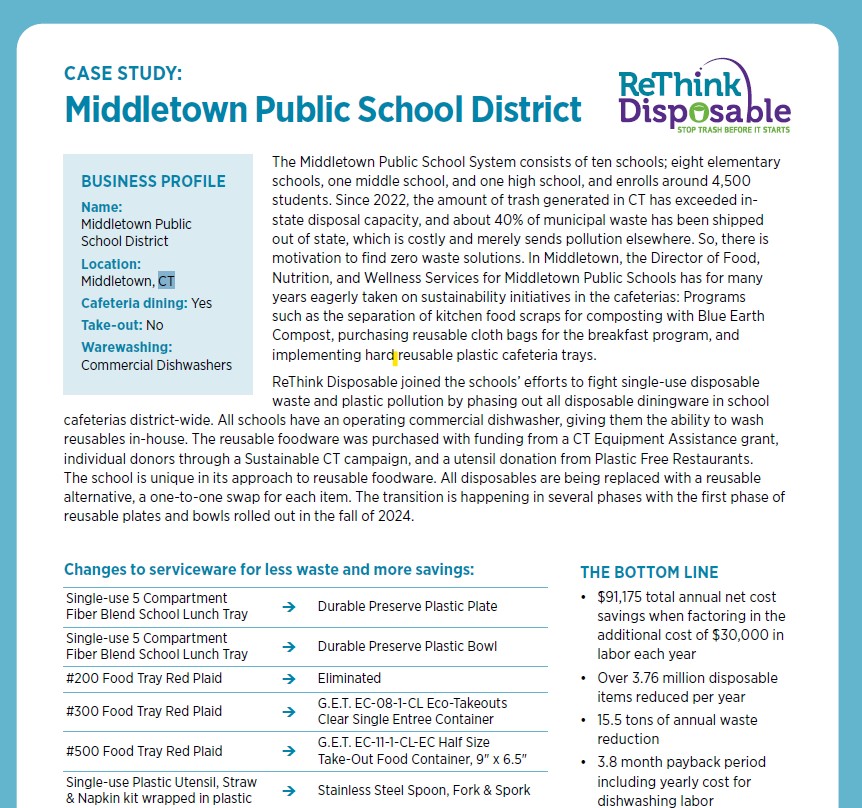
Middletown, CT Public School District
Since 2022, the amount of trash generated in Connecticut has exceeded instate disposal capacity, and about 40% of municipal waste has been shipped out of state, which is costly, so there is motivation for waste reduction statewide. The Middletown Public School System consists of ten schools (eight elementary schools, one middle school, and one high school) and enrolls around 4,500 students. For many years, the Director of Food, Nutrition, and Wellness Services has eagerly taken on sustainability initiatives in the cafeterias such as the separating kitchen food scraps for composting with Blue Earth Compost, purchasing reusable cloth bags for the breakfast program, and implementing hard reusable plastic cafeteria trays.
ReThink Disposable has joined the schools’ efforts to fight single-use disposable waste and plastic pollution by phasing out all disposable dining ware in school cafeterias district-wide. All disposables are being replaced with a reusable alternative, a one-to-one swap for each item. The transition is happening in several phases with the first phase of reusable plates and bowls rolled out in the fall of 2024.
All schools have an operating commercial dishwasher, giving them the ability to wash reusables in-house. The reusable food ware was purchased with funding from a CT Equipment Assistance grant, individual donors through a Sustainable CT campaign, and a utensil donation from Plastic Free Restaurants.
Read The Full Case Study Here (PDF)
ReThink Disposable is a program of Clean Water Action and Clean Water Fund conducted in partnership with local organizations, businesses, and government agencies. Generous support is provided by a changing list of public and private funders. To learn more about the program, its partners, and funders, visit: www.rethinkdisposable.org.
Packaging practices prior to ReThink Disposable:
- Single-use 5 Compartment Fiber Blend School Lunch Tray
- Single-use 5 Compartment Fiber Blend School Lunch Tray
- #200 Food Tray Red Plaid
- #300 Food Tray Red Plaid
- #500 Food Tray Red Plaid
- Take-Out Food Container, 9" x 6.5"
- Single-use Plastic Utensil, Straw & Napkin kit wrapped in plastic
- Single-use plastic 5.5 oz Portion Container
- Single-use plastic 5.5 oz Portion Container
- Clear Portion 5 oz/5.5 oz lid
- Ziplock Sandwich Bag
Recommendations Implemented:
- Durable Preserve Plastic Plate
- Durable Preserve Plastic Bowl
- #200 Food Tray Red Plaid - Eliminated
- G.E.T. EC-08-1-CL Eco-Takeouts Clear Single Entree Container
- G.E.T. EC-11-1-CL-EC Half Size Take-Out Food Container, 9" x 6.5"
- Stainless Steel Spoon, Fork & Spork
- G.E.T. EC-20-CL Sauce Cup 6.75 oz
- G.E.T. Eco-Takeouts 3 oz Jade Green Customizable Sauce Container
- Clear Portion 5 oz/5.5 oz lid - Eliminated
- Ziplock Sandwich Bag - Eliminated

Document
Business Information:
Middletown, CT 06457
United States
The Bottom Line
$91,175
net annual savings
3.76 million
disposable items reduced per year
15.5 tons
annual waste reduction
Here in Middletown Public Schools, one of our goals in switching to reusable utensils and servingware is to utilize the funds that would have gone to disposable items and instead reinvest them into the quality of our food. It was estimated that in this switch we will be saving around $100,000 per school year; with this savings we will focus on buying locally grown foods from small farmers and growers throughout the state of Connecticut with a specific focus in supporting farmers and growers of color. These funds will greatly improve our quality of food and bring more variety to our students during mealtimes.
Reducing Single-Use Food Packaging
ReThink Disposable works with local governments, businesses and institutions, and consumers of single use food packaging to inspire a cultural shift away from single-use "throwaway" lifestyle.
Curt Moultine
Curt began his canvassing career with the Michigan Citizen’s Lobby in August of 1989. He became Canvass Director for Georgia Citizen Action in March of 1991 and continued in the same role for Clean Water Action in Lansing, Michigan from 1993 until 2001. Among his accomplishments as a Canvass Director, Curt promoted over a dozen staff members who went on to become Canvass Directors and Program Directors. In his current role with the Hudson Bay Company, Curt works with the Michigan Clean Water Action field canvasses. He currently resides in Charlotte, Michigan with his wife Carol. They have 3
Emily Woodcock
Emily began at Clean Water Action in September 2004 in Ann Arbor where she filled several roles such as Senior Field Manager, before her current position as Canvass Director. She also canvasses two days a week, and immensely values her time spent training staff and organizing in the community. Emily grew up near Philadelphia, raised by parents who taught her early on the importance of working to better the community in which she lived. Before working for Clean Water Action, Emily spent a year as a Field Manager at the Rape Assistance and Awareness Program in Denver. She also has a degree in
Sean McBrearty
Sean learned the importance of protecting drinking water and our environment from a young age, growing up in a community devastated by perennial droughts and poor water and air quality in California’s central valley. He worked briefly as a firefighter before leaving California to attend school at Franciscan University in Ohio, where he studied History. Sean married his wife, Rose, in 2010 and moved to Grand Rapids, where he worked retail before joining Clean Water Action in Lansing in 2011. Sean started out as a canvasser, became a Field Manager, then Senior Field Manager, and became the