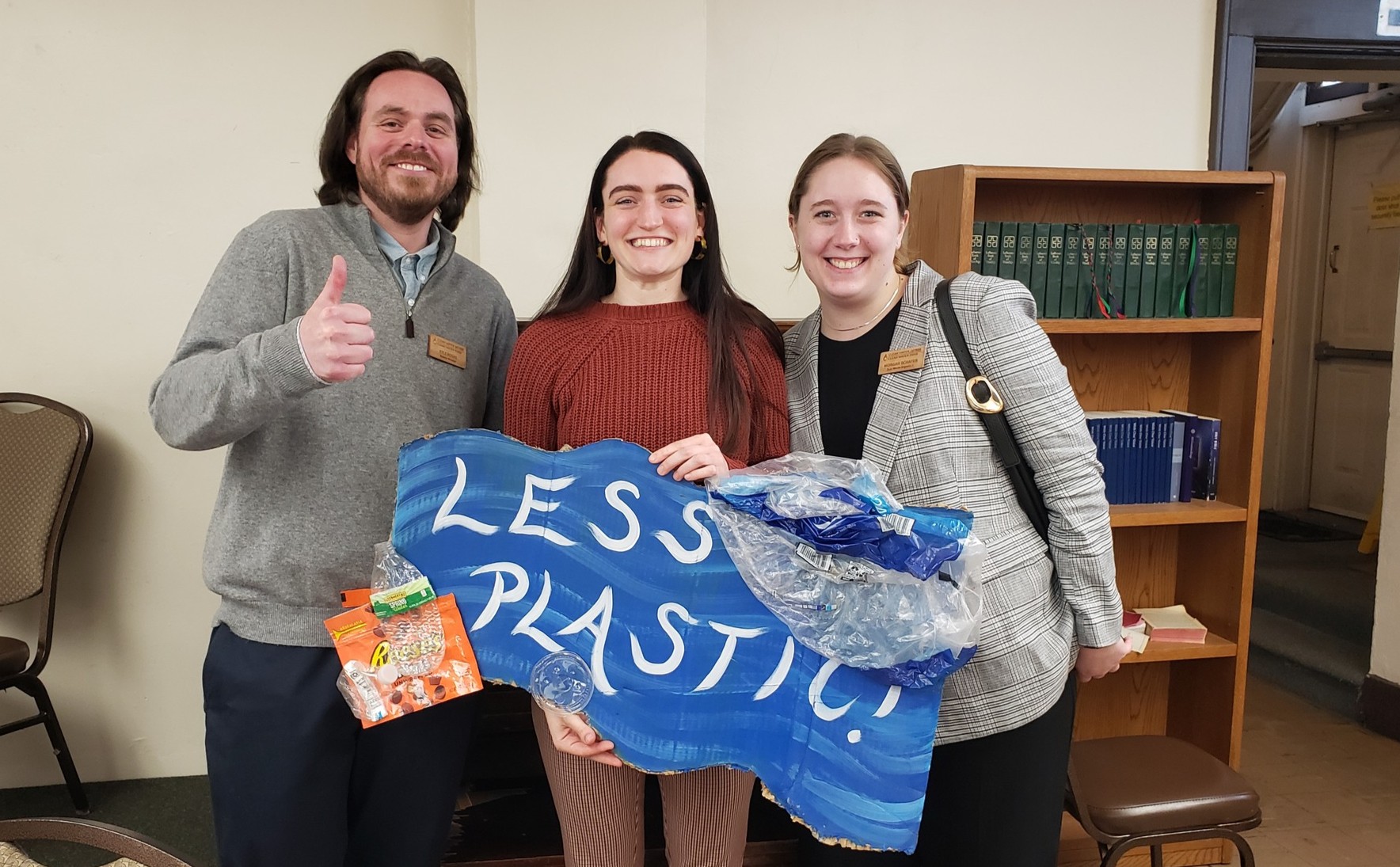
For the past two years, I’ve had the opportunity to lead Clean Water Action’s ReThink Disposable work across the state of Minnesota. As I wrap up this program, I’ve been thinking a lot about what I’ve learned from working directly with businesses, schools, and other organizations that are trying to reduce their reliance on single-use plastic.
ReThink Disposable is built around a simple idea: the most effective way to deal with plastic waste is to prevent it from becoming waste in the first place. Instead of relying on recycling or asking people to make better choices after a disposable product has already been purchased, we worked with organizations to identify where they could eliminate single-use items and switch to reusable alternatives.
Over the last two years, I’ve gotten to see what that looks like in practice.
I worked with businesses like Fawkes Alley Coffee to look at their day-to-day operations and find realistic opportunities to reduce single-use products. I also worked with schools, including Duluth East High School, where we worked with students and staff on a breakfast pilot and began looking at how those changes could expand into lunch. Duluth East serves more than 200 breakfasts and around 800 lunches every day, so even relatively small changes in how food is served can have a significant impact when that change is implemented hundreds or thousands of times.
That has been one of my favorite parts of this work. It’s one thing to talk about plastic pollution as a massive environmental problem, but it’s another to sit down with a business owner, school staff member, or student and figure out where plastic is actually being used and what it would take to change that. The solutions are often much more practical than they initially seem.
And, importantly, these changes make financial sense, too.
The impact of two years of ReThink Disposable
Collectively over the course of the program, our participating organizations have achieved:
- $13,747.6 in annual cost savings
- 220,000 single-use plastic items diverted from the waste stream
- 7,748.4 pounds of plastic diverted from landfills
These numbers are a useful way to understand the scale of the program, but they don’t tell the whole story. Behind every number is an organization that changed the way it operates, a student who helped rework how their school serves food, or a business that decided to try something different.
After two years of doing this work, I also came away with a broader lesson about how we address plastic pollution.
There's a lot that individual businesses, schools, and institutions can do. ReThink Disposable showed that reducing plastic usage at the source works, and that there are often practical and financially beneficial ways to eliminate single-use plastic. But voluntary action has limits. We can work with one business at a time, but we will never be able to reach every business, school, restaurant, and institution in Minnesota through individual projects alone.
That’s why, as Clean Water Action wraps up ReThink Disposable in Minnesota, we are transitioning our plastics work to focus more heavily on policy.
That shift is a natural next step based on what we’ve learned. If we want to meaningfully reduce plastic pollution, we need to change the systems that produce and use so much single-use plastic in the first place. State and local policies can create changes across entire communities and industries rather than relying on individual organizations to take action on their own.
My two years working on ReThink Disposable have made me even more convinced that reduction of plastics at the source has to be a central part of how we approach the plastics crisis. Recycling has a role to play, but we cannot recycle our way out of the amount of plastic being produced and thrown away. The most sustainable plastic waste is the plastic that never has to be produced, purchased, used, or thrown away.
I’m proud of what we were able to accomplish through ReThink Disposable in Minnesota, and especially grateful to all of the businesses, schools, students, staff, and community partners who were willing to rethink the way they use plastic.
While this particular Minnesota program is coming to an end, Clean Water Action's work isn’t. We’re taking what we learned from these projects and using it to push for policies that can make source reduction possible on a much larger scale.


