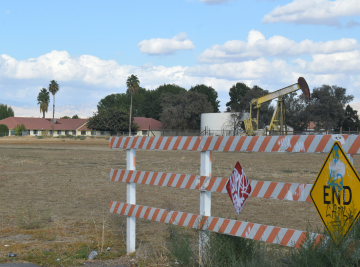
This year demonstrated why it’s so important that frontline communities have a voice in decision-making that impacts their health and safety. A large part of Clean Water’s oil and gas work is based in Kern County, which already has the dubious distinction of having the poorest air quality in the country, and where communities are doubly impacted by their proximity to oil and gas operations and other polluting industries.
That’s why Clean Water Action works in impacted communities. Our work involves listening to their concerns and priorities and finding ways to address them.
Local Community Emission Reduction Plans (LCERP)
This year we’ve been focusing on the development and implementation of Local Community Emission Reduction Plans (LCERP). These are locally-developed plans intended to identify investments that will improve local air quality and community health. Clean Water Action has been working in Arvin, whose LCERP was adopted in 2022. In accordance with the LCERP, this community is erecting vegetative barriers near sensitive receptors like schools and hospitals to protect them from neighboring pollution sources; creating sidewalks, bike lanes and a bus stop on a busy road; and working towards cleaner air by addressing lawn equipment and home air purifiers. In Lost Hills, Clean Water Fund is using a grant from the California Air Resources Board (CARB) to create a LCERP for this area, which will be completed next spring. Another grant will allow us to conduct a health assessment in the community to identify possible links between local pollution sources and public health outcomes, which will help hone in on the most pressing issues to address.
Data is Key
Data is key to identifying challenges and solutions, and we made great strides this year in understanding air quality in Lost Hills. Working with CARB, Study of Neighborhood Air Near Petroleum Sources (SNAPS) program, and the State Mobile Monitoring Initiative (SMMI), we're developing a more comprehensive understanding of local air quality. The initial round of SNAPS air monitoring in Lost Hills focused on Acrolein, a chemical used in both industry and agriculture that has recently been identified as a likely carcinogen. This monitoring effort revealed Acrolein present in Lost Hills at nearly three times the level of nearby communities.
In 2025, we began a second round of SNAPS monitoring focused on Acrolein to collect more data to use in advocacy efforts moving forward. According to community accounts, the mere presence of air monitors in the community has already improved air quality and the incidence of nauseating odors is significantly less frequent. Next year, we're expanding the initiative to add indoor air monitors and purchase new monitoring equipment for Lost Hills Elementary School, funded by a grant from CARB.
Legislative Setbacks
On the flip side, actions in the state legislature this year demonstrated what happens when community voices aren’t heard. In June, the governor pushed through language reducing California Environmental Quality Act (CEQA) protections by linking passage of the measure to budget approval. One of the more controversial parts of the bill streamlines approvals of so-called “advanced manufacturing.” In communities that are already home to multiple polluting industries, this measure allows siting of even more industrial development with limited review.
Then, in the last week of session, the legislature approved SB 237 to adopt a Kern County ordinance as state law — a controversial ordinance which has been twice challenged by impacted communities in Kern and subsequently overturned by courts. It provides blanket approval for up to 2,000 new oil wells per year in Kern County. Fortunately, there is a previously-won measure in place to help protect public health: new wells have a mandatory 3500-foot setback from sensitive receptors. This measure had been sought by the local community, passed by the legislature, and upheld by voters.
But overall, these two state-level measures will make it more difficult to protect communities from air pollution. Clean Water Action is currently working with advocates in the state legislature to pass a bill (AB 1083, Conolly) to amend the definition of advanced manufacturing and provide greater protection to community health.
None of this would be possible without your support and contribution. We all have a part to play in this revolution, and by reading this, keeping your eyes on our issues and supporting in whatever way you can, you are doing your part. We look forward to locking arms and marching forward into 2026. Thank you again, and Happy New Year!
Your voice matters. Every time you open one of our emails, sign a petition, or send a message to your state representatives, you help move decision-makers to act. Legislators and regulators have told us directly that your messages get through— and that they pay attention.
Your financial support powers change. When you give to Clean Water Action or Clean Water Fund, your gift helps us make change through education, advocacy, research and outreach to protect public health and the environment.
At a time when federal protections are being rolled back and efforts are underway to weaken California’s stronger environmental laws, your support—both your actions and your donations—is an investment in a safer, cleaner future for all.


